
Written and clinically reviewed by Cheryl Groskopf, LMFT, LPCC
Trauma-Informed Somatic & Attachment Therapist in Los Angeles
Last Updated: May 2026
You’re mid-conversation and something in you just goes quiet. Your body gets heavy, your words dry up, and you’re suddenly somewhere behind yourself — present enough to nod and respond, but not actually there. It happens in relationships, in therapy, after conflict, sometimes for no reason you can name. And for most people, it has never had a real explanation.
That experience is called dorsal vagal shutdown — a nervous system freeze response rooted in trauma and early attachment. Learning what drives dorsal vagal shutdown, what it feels like in the body, and what actually helps the nervous system come back online is often what makes healing feel possible for the first time.

Dorsal vagal shutdown is a nervous system survival response — the body’s most primitive protective state. It happens when the body determines that fighting or fleeing is no longer possible, and going “offline” is the only remaining option. Based on polyvagal theory, developed by Dr. Stephen Porges, this is the lowest rung of the autonomic ladder: a state of collapse, freeze, and disconnection that isn’t chosen, but activated automatically when the nervous system becomes overwhelmed.
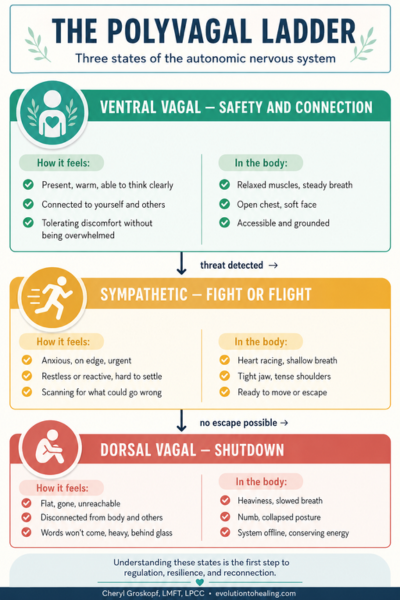
To understand dorsal vagal shutdown, it helps to understand the three-state model at the heart of polyvagal theory. Your nervous system operates through a hierarchy of states, each layered by evolution.
At the top is the ventral vagal state — the place of connection, calm, and presence. Here you can think clearly, feel warmly toward others, and tolerate discomfort without being flooded by it. This is where healing happens.
When something feels threatening, the system drops into sympathetic activation — fight-or-flight. The body mobilizes. Heart rate rises. This is uncomfortable, but it’s movement. The system is trying to do something to resolve the threat.
When fight-or-flight fails — when there’s no escape, no way to push back, no resolution in sight — the nervous system reaches for something older. The dorsal vagal state. Shutdown. The body’s last resort.
The dorsal vagal branch is the oldest part of the vagus nerve — a primitive survival circuit shared with animals far older than mammals. When it activates in response to threat, it does what ancient organisms have always done when cornered: it makes the body go still.
Heart rate slows. Breath becomes shallow. Digestion shuts down. The muscles lose tone. The mind goes foggy. Energy is conserved. In the animal world, this is the “play dead” response — an evolutionary strategy that has kept living things alive for hundreds of millions of years.
In a human nervous system, the same thing happens. When the threat is too big, too close, or too inescapable, the body decides that going quiet is safer than continuing to fight. This is deeply intelligent biology. What makes it painful — sometimes unbearable — is when that response gets stuck. When the body keeps choosing shutdown long after the original threat is gone. This is when dorsal vagal shutdown stops being a survival tool and starts shaping how someone moves through their entire life — their relationships, their work, their sense of self. This is also the pattern that somatic therapy in Los Angeles is specifically designed to reach.
Most descriptions of dorsal vagal shutdown focus on what it looks like from the outside, or what it means neurologically. The person living inside it knows something different entirely.
Words stop coming. The body gets heavy, leaden, like moving through something thick. You’re sitting in a conversation, watching your mouth move, saying the right things — but you’re somewhere else entirely. Some people describe going behind glass — they can see everything happening around them but can’t quite reach it. Others say their internal world just goes quiet, like a signal dropped mid-sentence and never came back.
This is what dissociation can look and feel like at the nervous system level — and it is far more common than most people realize.
One of the hardest things about this state is how invisible it can be. The person in shutdown often looks calm. They’re not crying, not panicking, not visibly distressed. Which means they are often dismissed — or they dismiss themselves, mistaking the experience for depression, exhaustion, or simply being “checked out.”
Dorsal vagal shutdown isn’t only a response to acute, overwhelming events. For many people, it became a learned pattern — the body’s way of surviving a relational environment where other options simply weren’t available.
When the source of danger is also the source of care, the nervous system faces an impossible bind. You can’t fight the person you depend on for survival. You can’t leave the home you need to grow up in. So the body finds a third way — it goes quiet. It withdraws. It learns that disappearing inside yourself is safer than reaching outward.
Over time, that response gets wired in. The nervous system begins to read certain relational cues — conflict, emotional unavailability, unpredictability, even closeness — as signals to shut down. This is why dorsal vagal patterns show up so often in people with a history of attachment trauma, early relational stress, or chronic emotional unavailability from caregivers.
This is also where complex PTSD and dorsal vagal shutdown so often overlap — the body learned that relationships meant danger, and shutdown became the most reliable way to stay safe inside them.
Understanding this reframes everything. The pattern is the nervous system doing exactly what it learned to do, in exactly the environment that taught it.
If you’ve spent time in a dorsal vagal state — chronic or episodic — you have probably tried to think your way out of it. To reason with yourself, identify what you’re feeling, use the tools you’ve been given. Maybe someone told you to just get out of your head, be more present, try harder to connect.
The reason those approaches fall short here has everything to do with what’s actually happening in the body. When the nervous system is in shutdown, the prefrontal cortex — the part of the brain responsible for reasoning, language, and self-reflection — goes dim. Logic and insight are simply not accessible in that state. You can’t think your way back into a body that has already left the room.
Willpower runs into the same wall. Shutdown is an activation, not a decision. The nervous system moved there automatically, below the level of conscious choice, because it read the environment as unsafe. Trying to override it with effort is like pressing the gas on a car that has already cut the engine — the mechanism that would respond to that input is offline.
This is also why people in chronic shutdown often carry a particular kind of shame. They know something feels wrong. They’ve tried to fix it. And when nothing has worked, they assume the problem is them. What they haven’t understood yet is that the nervous system itself needs a different kind of input — and that’s a very different thing than trying harder.
What actually moves the needle here is safety — specifically, the felt sense of it, not just the cognitive understanding of it. The nervous system learns through experience, and it needs repeated experiences of being in a body that feels safe enough to stay present in.
This happens through titration — small, manageable contact with sensation and emotion rather than flooding. It happens through co-regulation — being in the presence of a regulated nervous system so the body can begin to borrow that sense of safety. And it happens slowly, which runs counter to what most people expect from healing but is exactly what this kind of pattern requires. In my Los Angeles practice, serving clients in Silver Lake, Echo Park, and the Westside, this is one of the patterns I work with most.
Most therapeutic approaches work best when someone can access their thoughts, reflect on their patterns, and engage with language. When the body is in chronic shutdown, that access isn’t reliably there — and no amount of insight changes what the nervous system has learned to do automatically.
This is the pattern that somatic therapy in Los Angeles is specifically designed to work with — not by pushing the nervous system toward activation, but by helping the body learn that it is finally safe enough to come back. Somatic work doesn’t ask you to perform healing or demonstrate insight. It asks you to notice. To feel. To stay with what’s actually happening in your body, moment by moment, at whatever pace is tolerable.
In this kind of work, shutdown is understood as information — the body’s way of communicating what it once needed in order to survive. The goal is to expand the window within which you can tolerate more of your own experience without the system collapsing. This is what somatic experiencing and attachment-based approaches are designed to do — reach the places that language alone can’t.
The attachment thread matters here too. Because many of these patterns were wired in relationship, they often need relationship to heal. Working somatically within a therapeutically attuned connection offers the nervous system something it may never have had: the experience of being with another person and remaining safe. Over time, that experience becomes something the body knows — not just something the mind believes.
This is also why anxiety therapy in Los Angeles often intersects with dorsal vagal work — chronic anxiety and shutdown can look very different on the surface but share the same nervous system roots.
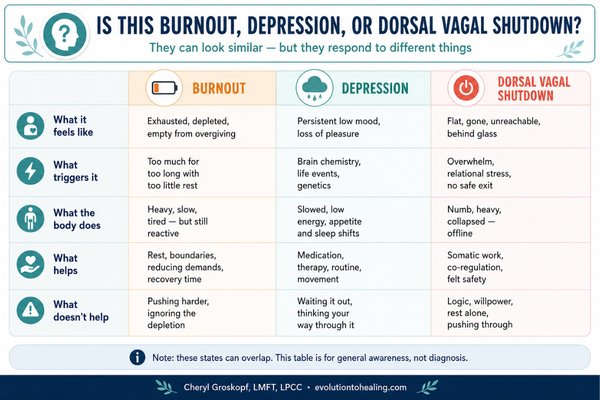
Dorsal vagal shutdown, burnout, and depression can look similar from the outside — flat, withdrawn, hard to reach. The difference is what’s driving it. Burnout comes from depletion. Depression carries its own neurological signature. Dorsal vagal shutdown is specifically a safety response — the nervous system’s way of going offline when it ran out of other options. Each one responds to something different, which is why getting clear on the distinction matters.
Burnout is about depletion. The system has given too much for too long and has run out of resources. Rest, reduced demands, and real recovery time usually begin to restore it. A true vacation that actually leaves you feeling more like yourself is a signal that burnout is a significant part of the picture.
Depression shows up as persistent low mood, loss of pleasure in things that used to matter, disrupted sleep and appetite, cognitive slowing. Depression and dorsal vagal patterns can absolutely coexist, but they respond to different things. Treating one as the other can mean years of trying approaches that only partially land.
The nervous system learned, at some point, that going quiet was the most protective option available. Some patterns that help distinguish it:
This is one of the most disorienting parts of chronic dorsal vagal patterns — rest doesn’t fix it. You can sleep a full night, take a weekend away, do everything right, and still feel flat, unreachable, gone.
What’s happening goes deeper than fatigue. The body has been shaped by repeated experience into a pattern where shutdown became the default response to overwhelm. Rest helps an overworked system recover. Rewiring a pattern the nervous system learned in order to survive requires something more specific than time off alone can offer.
The pace of this work is slow — and that’s the method, not the limitation. With patterns rooted this deep in the nervous system, moving too fast doesn’t accelerate healing. It replicates the overwhelm that created the pattern in the first place.
In sessions, we stay close to what’s happening right now — in your body, in this relationship, in this room. What activates? What quiets? Where does sensation show up, and what does it seem to be saying? This is somatic therapy at the level it’s actually designed to work — tracking the body’s language before it gets translated into words.
We go at your pace. Some sessions are slow and quiet. Some surface things unexpectedly. The therapeutic relationship itself is part of what heals — because for many people with dorsal vagal patterns, the experience of being with another person and staying regulated is genuinely new. That experience, repeated over time, is what teaches the nervous system that connection is safe.
This work tends to resonate with people who have tried other approaches and still feel like something isn’t quite reaching — like the healing is happening at the level of their thoughts but not landing anywhere deeper. That deeper place is where we work together.
Coming out of dorsal vagal shutdown starts with creating the conditions for safety — in the body, not just in the mind. The nervous system responds to felt experience, so the most effective approaches work at the level of sensation and presence rather than thought. Gentle movement, slow breath, co-regulation with a calm and attuned person, and titrated contact with sensation can all help the system begin to shift. For people with chronic or deeply wired shutdown patterns, working with a somatic therapist creates the kind of repeated relational experience the nervous system needs to learn that coming back online is safe.
It depends on whether the shutdown is acute or chronic. An acute episode — triggered by a single overwhelming moment — can shift within minutes to hours once the perceived threat has passed and the body feels safe again. Chronic dorsal vagal patterns, where shutdown has become the nervous system’s default response over months or years, take longer — typically weeks to months of consistent somatic and relational work. The timeline varies widely depending on the depth of the original wiring, the person’s nervous system history, and the quality of support they have access to.
Vagus nerve stimulation works by activating the ventral vagal branch — the part of the nervous system associated with safety, connection, and social engagement. Practices that support this include slow diaphragmatic breathing with an extended exhale, humming or singing, cold water on the face, gentle movement, and spending time in attuned connection with safe people. These are useful in the moment, and they build vagal tone over time. For people in chronic shutdown, these tools work best as part of a broader somatic practice rather than as standalone fixes, since the nervous system often needs more than a technique — it needs repeated experiences of relational safety to shift the underlying pattern. somatic therapy in Los Angeles is one of the most effective frameworks for building this over time.
Evolutionarily, yes — this is exactly what the dorsal vagal response was originally designed to do. In the animal world, this state is known as the “death feigning” or tonic immobility response. When an animal faces an inescapable predator, the dorsal vagal system triggers a collapse that mimics death — slowing the heart rate, dropping blood pressure, reducing pain sensitivity, and conserving energy. In humans, the same ancient circuitry activates in response to overwhelming or inescapable threat. The body isn’t actually preparing to die — it’s drawing on its oldest survival strategy. Understanding this reframes the experience entirely: shutdown feels like disappearing, but it is the nervous system doing everything it can to keep you alive.
Cheryl Groskopf is a trauma-informed LMFT and LPCC in Los Angeles specializing in somatic and attachment-based approaches to anxiety, trauma, and nervous system regulation. Her work focuses on helping people understand and heal the patterns their bodies learned in order to survive — including chronic shutdown, freeze, and disconnection. Learn more about Cheryl | Somatic Therapy in Los Angeles
If this resonates, you might find it helpful to explore what somatic and attachment-based therapy can offer. Learn more about working together.
