
Written and clinically reviewed by Cheryl Groskopf, LMFT, LPCC – Last updated January 2026
Inner child healing often starts with a quiet, frustrating question: Why does this still affect me?
You’re an adult. You’re capable. You’ve built a life. And still, certain moments — conflict, criticism, closeness, disappointment — can trigger reactions that feel fast, intense, and oddly familiar.
Early emotional experiences don’t disappear once childhood is over. They shape how your nervous system learned to respond to stress, connection, and safety. Inner child therapy works with those early patterns as they show up now — in your body, your relationships, and your anxiety — so they can begin to shift in real, lasting ways.
Inner child therapy is a therapeutic approach that works with early emotional patterns that still shape how you react as an adult. These patterns live in the nervous system and show up through anxiety, relationship responses, and body cues. Therapy focuses on how those early adaptations operate now — so they can shift in real, sustainable ways.
Inner child therapy shows up in the present — in moments when reactions feel automatic or difficult to interrupt.
That might look like freezing during conflict, scrambling to smooth things over, feeling suddenly small, or getting flooded with anxiety when someone’s disappointed. These responses tend to arrive quickly, before there’s time to think them through, because they were shaped early — when your nervous system was learning how to stay safe.
In therapy, the focus stays on what’s happening now: the emotional tone, the body response, the urge to act or shut down. Working this way helps those patterns loosen their grip, not through insight alone, but through new experiences of safety and choice.
Inner child work is most effective when it’s integrated into therapies that understand development, protection, and the nervous system.
That often includes:

Some reactions show up so quickly they feel like they bypass choice.
You might notice it during conflict, when someone pulls back emotionally, or when a relationship feels uncertain. A small shift in tone can spark panic. A delayed response can feel threatening. Closeness might bring relief one moment and overwhelm the next.
These reactions tend to trace back to earlier experiences where connection didn’t feel stable or predictable — and your nervous system learned to stay alert to changes.
For many people, this is where inner child patterns intersect with attachment — how the body learned to expect closeness, distance, or repair.
For others, the pattern shows up as constant self-monitoring.
You may feel responsible for keeping things smooth. You notice other people’s moods before your own. You replay conversations, second-guess decisions, or assume you did something wrong when tension appears.
These patterns often formed early, in environments where staying attuned to others felt necessary. Over time, that vigilance can turn inward as shame — a sense that mistakes are costly or that your needs create problems.
Inner child patterns often register in the body before they make sense emotionally.
You might notice a tight chest, a collapsed posture, shallow breathing, or an urge to shrink or disappear during stress. Some people feel frozen or foggy. Others brace, hold their breath, or disconnect without meaning to.
These responses developed early, when the body was learning how to reduce threat. Even years later, the body can still respond as if those conditions are present.
This is why body-based approaches matter for inner child healing — they work directly with the responses that formed before language or logic.
Early on, the nervous system is organized around one question: what helps me stay safe and connected here?
For a child, safety isn’t just physical. It’s emotional. It comes from being responded to, soothed, and repaired with when things go wrong. Over time, the body learns what to expect — whether emotions are welcomed, ignored, overwhelming, or risky to express.
When those needs were met consistently, the nervous system had room to relax. When they weren’t, it adapted by becoming more alert, more contained, or more focused on keeping the environment steady.
In emotionally immature environments, children often learn to adjust themselves rather than expect the environment to adjust to them.
That can look like becoming highly attuned to a parent’s moods, taking on responsibility early, or learning to downplay needs to avoid conflict. Over time, the body associates connection with vigilance — paying attention, staying flexible, and keeping things from tipping too far.
These patterns make sense in context. They helped the child stay oriented to what was required to maintain closeness or reduce tension.
If this dynamic feels familiar, it’s often part of growing up with emotionally immature caregivers.
Once the nervous system learns a reliable way to reduce threat, it tends to keep using it.
These early patterns don’t fade simply because you’ve grown up. They’re reinforced through repetition — especially in relationships, stress, or situations that echo earlier dynamics. The body responds first, often before there’s conscious awareness.
This persistence isn’t a flaw. It’s how learning works at the nervous-system level. Change happens when new experiences create a different sense of safety over time.
This is also why inner child work often overlaps with healing long-term trauma patterns.
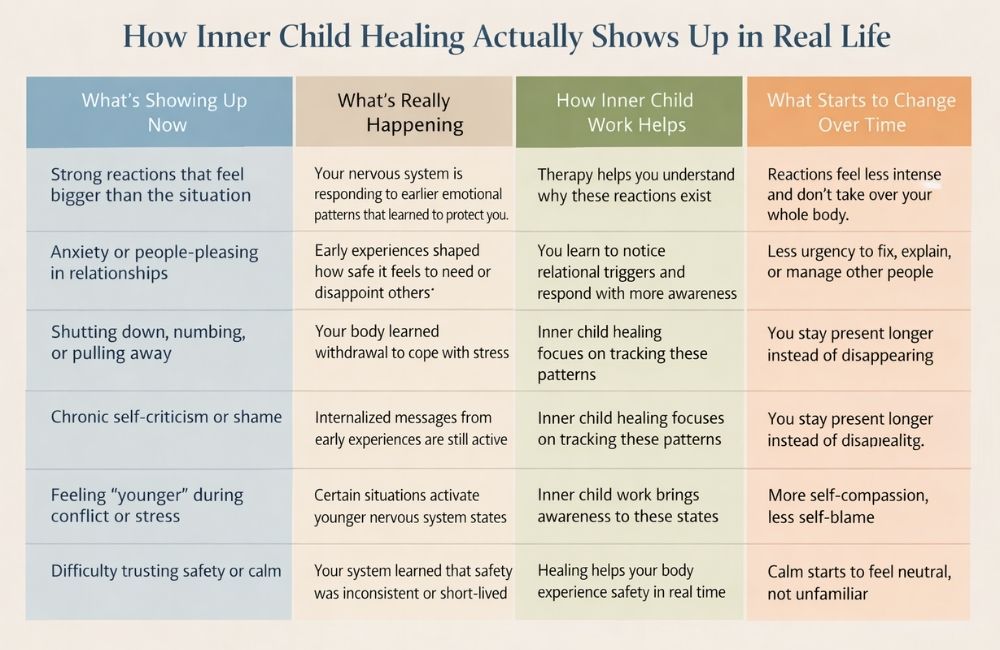
You usually don’t start off in therapy talking about an “inner child.”
It usually starts with a reaction that doesn’t quite make sense — feeling suddenly small, overwhelmed, defensive, or frozen in situations that don’t seem objectively threatening. Sometimes there’s a clear sense of age. Other times it’s just a shift in the body or emotional tone.
In sessions, those moments become information. The focus stays on what’s happening right then — how the body responds, what emotions surface, and what the nervous system seems to be preparing for.
Inner child therapy moves at the pace your nervous system can tolerate.
That means paying attention to protective responses as much as vulnerable ones. The goal isn’t to push past defenses or access emotion quickly. It’s to notice how different parts of you are trying to help — by staying alert, staying contained, or keeping things under control.
When therapy stays regulated, those parts don’t have to work as hard. Over time, reactions that once felt automatic start to feel more spacious and less urgent.
This approach overlaps closely with parts-oriented work (like Internal Family Systems) that helps different emotional states communicate rather than compete.
Because many inner child patterns formed before language, the body often leads the way.
Somatic work brings attention to posture, breath, tension, and impulses to act or withdraw. These cues offer clues about how the nervous system learned to respond early on — without needing to analyze or relive past events.
As awareness grows, the body has more options. Reactions slow. There’s more room to choose how to respond instead of being pulled into familiar patterns.
For many adults, anxiety isn’t about danger — it’s about anticipation.
You might feel on edge when someone’s tone changes, when authority figures are involved, or when you’re waiting for feedback. The body braces, scans, or tightens as if something bad is about to happen, even when there’s no clear threat.
Inner child therapy helps trace these reactions back to early experiences where approval, safety, or repair felt uncertain. When those patterns are recognized and worked with in the present, anxiety has less reason to stay so loud.
This is something I see often in anxiety work that focuses on nervous system responses.
Instead of clear memories, this can show up as emotional states that arrive suddenly — shame, panic, or shutdown — without an obvious trigger. The body reacts as if something from the past is happening again, even when life looks stable on the surface.
Inner child therapy helps by slowing these moments down and working with the response as it unfolds now, rather than trying to reason it away.
This overlap is common for people navigating complex trauma patterns over time.
People-pleasing is often a nervous system strategy, not a personality trait.
When staying attuned to others once helped maintain safety or connection, the body can continue prioritizing external cues over internal signals. That can lead to chronic self-monitoring, difficulty identifying needs, and anxiety around conflict or disappointment.
Inner child therapy supports people-pleasers by restoring self-reference — helping the nervous system notice internal cues again and tolerate moments of disagreement without going into overdrive.
A brief check-in you can use in the moment:
If writing is helpful for you, keep it narrow and time-limited.
Prompts that stay close to the present tend to be easier on the nervous system than wide-open reflection. A few that often feel manageable:
Stop after a few minutes. This isn’t about deep insight or resolution.
Some inner child patterns are easier to work with alongside support.
If checking in with these patterns leads to spiraling, shutdown, or overwhelm, that’s information — not a failure. Early adaptations often formed in relationships, and they tend to shift most reliably in a regulated, relational setting.
Working with a therapist can help keep the process paced, grounded, and oriented toward safety.

My approach to inner child therapy is grounded, relational, and nervous-system-informed.
I work with adults who are high-functioning on the outside but feel stuck in familiar patterns — anxiety that feels reactive, people-pleasing that’s hard to turn off, or relationship dynamics that don’t match who they are now.
Sessions integrate attachment-focused care, parts-oriented work, and somatic awareness. The goal isn’t to relive the past. It’s to help your system respond differently in the present, with more stability and choice.
Healing your inner child usually starts by noticing when certain reactions feel automatic or outsized — especially in relationships, conflict, or moments of stress. Instead of trying to change those reactions right away, the focus is on understanding what they’re protecting and how they show up in your body. Many people begin with gentle awareness and grounding, and choose to work with a therapist when patterns feel hard to interrupt on their own. You can also check out Healthline’s article on 8 ways to heal the inner child.
Inner child wounds aren’t fixed categories, but common patterns often include emotional neglect, inconsistent caregiving, parentification, chronic criticism, and a lack of repair after conflict. These experiences can shape how safe it feels to have needs, express emotions, or rely on others. In adulthood, they often show up as anxiety, people-pleasing, shutdown, or difficulty trusting closeness.
Healing the inner child doesn’t mean changing the past or reliving childhood experiences. It means working with how early emotional patterns still affect your nervous system now — especially your reactions, body responses, and sense of safety in relationships. Over time, healing shows up as more choice, less reactivity, and a steadier connection to yourself in the present.
You might notice feeling younger than your actual age in certain situations, becoming highly reactive during conflict, or struggling with shame, anxiety, or people-pleasing despite knowing better cognitively. These patterns often appear quickly and feel hard to control, especially in close relationships. That doesn’t mean something is wrong with you — it usually reflects early adaptations that are still active.

About the Author
Cheryl Groskopf, LMFT, LPCC, is a licensed psychotherapist in Los Angeles specializing in anxiety, trauma, inner child work, and somatic therapy. Her work focuses on helping people understand how early patterns still live in the nervous system — and how those patterns shift when the body feels safe enough to change. She works primarily with high-functioning adults who feel stuck in survival mode, people-pleasing, or relationship anxiety.
