
You’re always the strong one,
but you’re tired of holding it all together.














Holistic therapy is an approach to psychotherapy that looks at how your thoughts, emotions, physical responses, relationships, and daily life affect each other. It gives us a fuller picture of what you’re experiencing instead of treating each piece like it exists on its own.
In my practice, holistic psychotherapy brings together somatic therapy, attachment-focused work, and IFS-informed therapy. We might look at the thoughts you can’t turn off, what happens in your body under stress, patterns that keep repeating in your relationships, and how your history may be shaping what feels hard now.
We also pay attention to what’s happening in your life now: work stress, family dynamics, relationships, support, rest, and how much you’re carrying. Your history matters. So does the life you’re living today.
People rely on you. You get things done. You’re usually paying attention to what everyone else needs, what needs to happen next, or what could go wrong.
And maybe you’re starting to wonder what all of that is doing to you.
Maybe you:
You don’t have to come into therapy already understanding why you do these things. Part of the work can be getting curious about them together — where they started, what they’ve helped you do, what happens in your body when they show up, and what you might need now.
A lot of this work is about having more choice in the moments that usually feel automatic. You start to notice what’s happening earlier, understand why it’s happening, and figure out what you need in that moment.
The more you understand your patterns, the easier it becomes to notice them while they’re happening. That gives us something to work with together.
In our first sessions, we’ll talk about what brought you in, what you’d like to change, and where it makes sense to begin.
Then we discuss what’s actually happening in your life. Maybe you had a fight with your partner, can’t stop thinking about something you said at work, or notice that your body has been tense all week even though you can’t point to one obvious reason.
We can slow that moment down and get curious about it. What happened right before you reacted? What did you notice in your body? What were you afraid might happen? Did any part of the situation feel familiar? When have you felt this way before?
Sometimes that takes us into your history. Sometimes we stay with what’s happening right now. We might notice a physical response, get curious about a part of you that immediately wants to fix things, or practice staying with a feeling long enough to understand what it’s asking for.
I’m active in sessions. I’ll ask questions, point out patterns I’m noticing, explain why I’m suggesting something, and check in with you about how it’s landing. You can tell me when something doesn’t fit, when you want to slow down, or when you want to go deeper.
Over time, we start connecting the dots between what happened then, what happens now, and what your mind and body learned to do to get you through it.
I offer free phone consultations where you can tell me a little about what’s bringing you to therapy, ask questions, and get a sense of what it would be like to work together.
I’m Cheryl Groskopf, a Licensed Marriage and Family Therapist and Licensed Professional Clinical Counselor based in Los Angeles. I’m the founder of Evolution to Healing, where I work with adults throughout California.
I specialize in anxiety, trauma, attachment, people-pleasing, perfectionism, and relationship patterns. I’m especially interested in understanding how these patterns developed, what keeps pulling you back into them, and what happens inside you when they get activated.
My approach brings together somatic therapy, attachment-focused work, and IFS-informed therapy. We can look at your history, relationships, thoughts, emotions, and what your body is doing in the moment. All of it gives us information.
My work and perspective on mental health have been featured in TIME, Vogue, Cosmopolitan, HuffPost, Good Morning America, and other national publications.
California licenses: LMFT #122530 · LPCC #10096
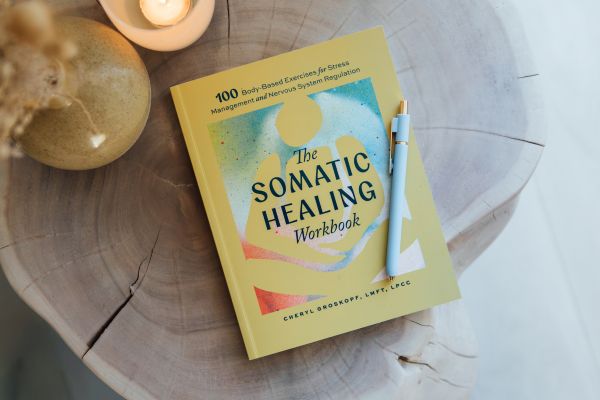
I’m also the author of The Somatic Healing Workbook, a practical guide with 100 exercises organized around fight, flight, freeze, and fawn. I wrote it to help you recognize what’s happening in your body when you’re stressed and find a practice that matches what you actually need.
Published by Blue Star Press and distributed by Penguin Random House.
Holistic therapy gives us room to work with different parts of your experience. What we focus on depends on what’s coming up for you, what we’re trying to understand, and what feels useful in that moment.
Your body can give us information that’s easy to miss when we’re focused on your thoughts. In somatic therapy, we might notice that you hold your breath when you talk about something, feel restless when you try to slow down, go blank during conflict, or suddenly feel an urge to fix things when someone else is upset. Getting curious about those responses can help us understand what your nervous system is responding to and what it may need.
The way you learned to connect with other people can show up in how you handle conflict, ask for what you need, respond when someone is disappointed in you, or start worrying when something feels off. With attachment-focused therapy, we can explore where those patterns came from, what shaped them, and how they’re showing up in your relationships now.
Sometimes different parts of you want completely different things. One part wants to move forward. Another wants to pull back. Another is trying to make sure you don’t make the wrong decision. IFS therapy gives us a way to slow those responses down and get curious about what each part is worried about, where it may have learned to respond that way, and what it’s trying to do for you.
Past experiences, including trauma and complex PTSD (CPTSD), can shape how you respond to stress, conflict, and closeness today. We’ll explore those connections at a pace you have a say in. You can choose what to share, pause when you need to, and work on what’s affecting your life now without going through every detail of your past.
My practice is based in Los Angeles, and I work with adults throughout California. Sessions are 50 minutes and typically meet weekly, giving us enough consistency to build on what we’re exploring together.
The fee is $250 per 50-minute session. I’m an out-of-network provider and can provide a superbill that you can submit to your insurance company for possible reimbursement, depending on your plan.
If you’re thinking about starting therapy, I offer a free 15-minute phone consultation. You can tell me a little about what’s bringing you in, ask questions, and see how it feels to talk with me before deciding whether you’d like to schedule a first session.
Somatic therapy focuses on how your body and nervous system are involved in your emotional experience. Holistic therapy looks at the broader picture, including your thoughts, emotions, body, relationships, history, and current life.
In my practice, somatic therapy is just one part of a holistic approach.
Holistic therapy can help with anxiety, trauma, people-pleasing, perfectionism, relationship patterns, and stress that shows up in different parts of your life. We can explore what triggers a pattern, where it may have started, what happens in your body when it shows up, and what you need now.
No. Holistic therapy can be grounded entirely in psychotherapy and doesn’t require any particular spiritual beliefs or practices.
In my practice, “holistic” means looking at the whole picture: your thoughts, emotions, body, relationships, history, environment, and what’s happening in your life now.
Holistic therapy is a broad approach, so the evidence depends on the specific method and the concern being treated. The amount and quality of research vary across methods. In my practice, I use attachment-focused, somatic, and IFS-informed work. We’ll discuss why I’m suggesting an approach, what its limits are, and whether it’s helping.
An example of holistic treatment is exploring a stressful situation through several parts of your experience: your thoughts, emotions, physical responses, relationships, history, and what’s happening in your life now.
If a conversation leaves you anxious, for example, we might explore what your mind keeps replaying, what happens in your body when you think about it, and why that interaction affected you so strongly.
If you’re curious about working together, we can start with a free 15-minute phone consultation. You can tell me a little about what’s bringing you to therapy, ask any questions you have, and get a sense of whether I might be a good fit for what you’re looking for.
