
By Cheryl Groskopf, LMFT, LPCC | Last Updated July 2026
Cheryl Groskopf is a licensed Marriage and Family Therapist and Professional Clinical Counselor specializing in somatic and attachment-based trauma therapy in Los Angeles. Her work has been featured in TIME, TODAY, HuffPost, ABC News, Bustle, Cosmopolitan, and mindbodygreen.

The definition of fawning is a trauma response in which your nervous system automatically pleases, appeases, or accommodates someone else in order to feel safe. It shows up as over-apologizing, agreeing before you’ve had a chance to think, or reading a room the second you walk into it — patterns your body built to protect you, and still runs today.
Fawning means your body defaults to appeasing others as its first response to perceived threat, rather than fighting, fleeing, or freezing. This happens involuntarily — a nervous system reflex, not a conscious decision — and it activates before you’ve had a chance to register what you actually want.
Your body built this response for a reason. At some point, keeping someone else calm or happy was the fastest path back to safety, and your nervous system learned the move so well it now runs on autopilot. A tightened shoulder, a quick “sorry,” a yes that leaves your mouth before you’ve thought it through — these are trained reflexes, wired into the body through repetition.
This is what defines fawning as a trauma response specifically: the speed and automaticity of it. Your nervous system scans for tension in a room and moves to soothe it within seconds, often before you have language for what just happened in your body.
The fawning trauma response is your nervous system’s way of using appeasement to regulate danger. Rooted in the body’s threat-detection system, it activates alongside fight, flight, and freeze as a fourth survival strategy — one built specifically for situations where conflict itself felt unsafe.
Your nervous system runs a constant, wordless assessment of the people around you — a process Dr. Stephen Porges terms neuroception, describing how the ventral vagal complex facilitates social behavior through mechanisms including neuroception and co-regulation, detecting safety or threat below conscious awareness. Long before you consciously register tension in a room, your body has already picked up on it: a shift in tone, a stiffened posture, a pause that lasts half a second too long. Fawning is what happens when that detection system decides the safest response is closeness instead of distance.
Fawning moves you toward the source of danger instead of away from it. Where fight and flight mobilize you to resist or escape, and freeze suspends you in place, fawning sends you straight into connection — your body’s bet that staying close and keeping the other person calm offers more protection than running or resisting. That’s often the case in a relationship where leaving or fighting back isn’t safe or possible, which is where trauma therapy in Los Angeles can help you build new options your nervous system didn’t have access to before.
Fawning shows up in patterns you can learn to recognize: agreeing before you’ve thought something through, apologizing for things that aren’t yours to apologize for, and scanning a room for tension before you’ve even set down your bag. These signs live in the body first, often before your mind catches up.
Your body carries this pattern into daily moments, often ones that feel too small to name:
You Might Notice:
Afamiliar tightness in your chest right before you’re about to disagree with someone — followed by the words coming out softer, or not coming out at all.
These patterns build over years, which means unwinding them happens the same way: gradually, through practice your nervous system can actually feel and trust.
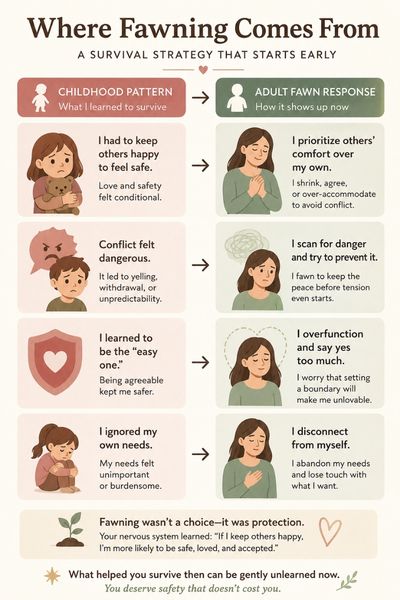
Fawning develops early, usually in relationships where a child learned that their own needs took a back seat to someone else’s mood. A caregiver’s unpredictability, an environment where conflict felt dangerous, or a home where love came with conditions all shape a nervous system to prioritize appeasement as its go-to trauma response.
Children read their environment constantly, adjusting themselves to whatever keeps connection intact. When a caregiver’s love feels conditional — available on good days, withdrawn on hard ones — a child’s nervous system learns to manage the caregiver’s state as a form of self-protection. Staying attuned to someone else’s mood becomes the price of staying safe.
This pattern often takes root through repeated relational experiences over time, though a single frightening event can also wire it in. Research distinguishes childhood adversity marked by threat — like unpredictable anger or caregiver conflict — from adversity marked by deprivation, finding that threat-based experiences carry their own distinct impact on the body’s stress-response systems, separate from other forms of hardship. A parent who needed to be managed rather than the other way around, or a home where a child’s own feelings consistently came second, can teach a nervous system that this trauma response — fawning — keeps the peace.
For some, this pattern traces back to a broader history of attachment wounds that shape how safety and closeness get defined well into adulthood. For others, it connects to a longer pattern of relational trauma, which complex PTSD therapy is built to address directly. Both paths lead to the same place: a nervous system that learned appeasement early, and a body that can learn something different now.
Fawning and people pleasing can look similar on the surface, but they come from different places in the body. People pleasing often comes from genuine warmth and a preference for harmony, while fawning runs on threat detection — an automatic bid for safety that activates whether or not real danger is present.
Someone who enjoys making others happy typically has access to their own preferences too. They can plan a group dinner around everyone else’s favorite restaurant and still speak up when a Tuesday truly doesn’t work for them. Their generosity flows from choice.
Fawning operates on a different timeline entirely. The response fires before conscious choice enters the picture — a yes leaves your mouth, your body softens, your opinion reshapes itself to match the room, all within seconds and all before you’ve had a chance to check in with what you actually think. This speed is the signature of a nervous system responding to perceived threat, running the same protective sequence that once kept you safe.
Telling the two apart in your own life often comes down to a simple check-in: after you agree to something, does a quiet resistance show up moments later? That gap between the yes and the feeling underneath it is often where fawning reveals itself. I’ve written more on this distinction for mindbodygreen, breaking down the specific childhood patterns that shape a fawn response into adulthood.
In relationships, fawning often looks like constant accommodation — agreeing to plans you don’t want, apologizing first even when you weren’t wrong, and staying quiet about needs that matter to you. Your nervous system prioritizes your partner’s comfort as a way of protecting the connection itself.
A relationship built on fawning can look happy from the outside. You show up agreeable, easy, low-maintenance — the partner who never causes friction. Underneath, though, a quieter pattern runs the show: your preferences shrink to fit whatever keeps the peace, and your own needs move so far to the background that naming them starts to feel indulgent, even unfair to ask for.
This shows up in small, repeated moments. Choosing a restaurant you don’t actually want because your partner mentioned liking it once. Saying “I’m fine” when you’re not, because bringing up the real feeling risks a conversation you’re not sure you can handle. Taking responsibility for a conflict that wasn’t yours to carry, simply because smoothing it over feels safer than sitting in the tension.
Over time, this pattern can leave a relationship feeling one-sided, even when both people care deeply. A partner can’t respond to needs they don’t know exist. Fawning keeps your real self just out of view — protecting the relationship in the short term, while quietly starving it of the honesty that makes closeness possible. Working with a somatic therapist in Los Angeles can help you practice naming a need in real time, in a relationship built to hold it.
At work, fawning often looks like over-functioning — saying yes to every request, staying quiet in meetings even when you disagree, and taking on tasks that aren’t yours to protect the peace of the team. Your nervous system reads workplace tension the same way it reads any other threat, and appeasement becomes the default response.
A fawn response at work can look a lot like being a great employee. You’re responsive, agreeable, easy to work with — the person who never pushes back. But underneath that reputation, a familiar pattern runs quietly: you agree to a deadline you know is unrealistic rather than raise a concern. You rewrite an email five times to soften a request that was reasonable to begin with. You absorb a colleague’s bad mood as something you need to manage, even when it has nothing to do with you.
This often traces back to the same wiring that shapes fawning everywhere else — a nervous system that learned, early on, that keeping others comfortable was the safer move. In a professional setting, that wiring can look like ambition from the outside, even while it quietly drains you from the inside.
Over time, this pattern can cost you real opportunities. Ideas go unspoken in meetings. Boundaries around workload never quite get set. Credit gets shared away rather than claimed. Learning to notice the fawn response in real time — the tightened chest before you speak up, the reflexive yes before you’ve thought it through — is often the first step toward showing up at work as your full self, not just your most agreeable one.
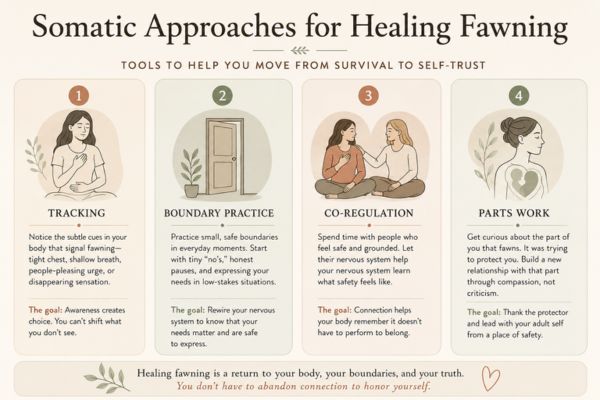
Somatic therapy works directly with the body’s fawn response, rather than only addressing it through insight and conversation. Techniques like nervous system tracking, boundary practice in real time, and co-regulation with a trusted person help retrain the automatic patterns that talk therapy alone often can’t reach.
Fawning lives in the body first — a tightened chest, a softened voice, a yes that arrives before thought does. Talk therapy can help you understand where the pattern came from. Somatic work helps your nervous system actually feel something different, building new options in real time instead of just naming old ones. Research on body-oriented trauma therapy shows promising effectiveness, though the field continues building a stronger evidence base through controlled studies.
Learning to notice the exact moment your body starts to fawn — the tightening, the softening, the urge to smooth things over — creates a pause where none existed before. That pause is where change becomes possible.
Saying no to something small, in a space that feels safe, builds the same muscle you’ll eventually use in harder moments. This is often where clients feel the shift first — not in a big confrontation, but in a low-stakes practice round that proves their body can handle it.
A fawn response often develops in relationships where safety depended on another person’s mood. Healing it can involve experiencing the opposite — a steady, attuned presence that doesn’t require you to perform or appease to stay connected.
Understanding the fawn response as a part of you that adapted to protect you, rather than a flaw to eliminate, often changes the entire relationship to the pattern. The part did its job. It’s allowed to rest now.
If you’re ready to explore what this looks like in practice, working with a somatic therapist in Los Angeles offers a place to start — one where your nervous system, not just your understanding, gets to change.
Fawning often goes unnoticed for years because it looks like a strength — being agreeable, low-maintenance, easy to work and live with. Seeking support makes sense when you notice the pattern costing you more than it protects: relationships that feel one-sided, exhaustion that doesn’t lift, or a growing distance from what you actually want.
A few signs it might be time to reach out:
If saying yes leaves you quietly keeping score, or agreeing to things builds a low hum of frustration you can’t quite place, your body may be signaling that the pattern has run its course.
When someone asks what you want — for dinner, for the weekend, for your life — and you draw a blank before you can answer, that’s worth paying attention to. Fawning can quiet your own voice until it’s genuinely hard to hear.
The vigilance fawning requires — tracking every mood, managing every reaction — is its own kind of labor. It’s the kind of tired that a weekend off doesn’t touch, because the nervous system never fully powers down.
Sometimes the clearest sign isn’t a crisis at all — it’s simply wanting more ease, more honesty, more of yourself back in your own life. That’s more than enough reason to start.
Support can look like trauma therapy in Los Angeles, where the work addresses fawning at its root, or a first conversation to talk through what you’re noticing. Reach out here to schedule a consultation and start building a nervous system that doesn’t have to perform to feel safe.
If you’re in crisis or experiencing thoughts of self-harm, please reach out to the 988 Suicide & Crisis Lifeline by calling or texting 988, available 24/7.
Fawning means automatically pleasing or appeasing someone else as a trauma response, in order to feel safe. It’s an involuntary nervous system reflex, not a conscious choice.
A person who is fawning is automatically appeasing or accommodating someone else in response to perceived tension, often through over-apologizing, quick agreement, or shifting their opinion to match the room. The behavior is an involuntary nervous system response rather than a personality trait.
A fawn behavior is any automatic action your body takes to keep another person calm or comfortable in order to feel safe — common examples include agreeing before you’ve thought something through, apologizing reflexively, or scanning someone’s mood before speaking.
A common example of fawning is agreeing to plans you don’t actually want, then feeling a wave of resentment or resistance minutes later. Other examples include over-apologizing for things outside your control, rewriting a message multiple times to soften a reasonable request, and taking responsibility for a conflict that wasn’t yours to carry.
Cheryl Groskopf is a licensed Marriage and Family Therapist and Professional Clinical Counselor based in Los Angeles, specializing in holistic somatic therapy, attachment work, and nervous system regulation. She works with high achievers, caretakers, and people-pleasers who look put-together on the outside while carrying anxiety, overwhelm, or chronic tension underneath — helping them build a felt sense of safety in the body, not just an intellectual understanding of their patterns.
Her writing and clinical expertise have been featured in TIME, TODAY, HuffPost, ABC News, Bustle, Cosmopolitan, and Vogue.
Cheryl is the author of The Somatic Healing Workbook, releasing November 3, 2026 from Blue Star Press and Penguin Random House. The book offers more than 100 body-based exercises organized around fight, flight, freeze, and fawn — the same nervous system patterns explored in this post — giving readers practical tools to recognize their own responses and build new ones. Order your copy here.
Ready to explore this work in your own life? Schedule a consultation with Cheryl to begin somatic therapy in Los Angeles.