Cheryl Groskopf, LMFT, LPCC is a Los Angeles-based somatic and attachment therapist featured in Time, Mindbodygreen, HuffPost, Parade, and Verywell Mind. She is also the author of The Somatic Healing Workbook 100 Body-Based Exercises for Stress Management and Nervous System Regulation.
Have you ever felt like you can’t fully relax, even when everything around you is calm? Like part of you is always scanning, bracing, waiting for something that never comes? If you’ve been searching for hypervigilance meaning, you’re probably already living it — and yes, it’s exhausting.
Hypervigilance is your nervous system’s way of staying one step ahead of danger after stress, trauma, or emotionally unpredictable experiences taught your body that staying alert was necessary. As a somatic therapist in Los Angeles, I work with this pattern constantly in my practice. Here’s what hypervigilance really means, why your nervous system learned it, and what becomes possible when your body starts to feel safe again.

Hypervigilance means your nervous system is in a state of sustained, heightened alertness — constantly scanning for danger even when your environment is safe. It develops most often from trauma, chronic stress, or anxiety that taught your body staying on guard was necessary for survival. Hypervigilance lives in the body as much as the mind, and it is formally recognized as a clinical symptom of PTSD in the DSM-5.
The human body is designed to get really good at prediction. If you grew up needing to read the room fast, track moods, anticipate conflict, or stay emotionally prepared for sudden shifts, your nervous system learned that vigilance kept you safe. Eventually that alertness stops feeling temporary and starts feeling like your new baseline.
What makes hypervigilance different from ordinary stress or caution is the persistence of it. There is no off switch, so the body stays braced and it can feel like the scanning never really stops. Some people describe it as a kind of exhausting background noise, even in moments that should feel safe.
Hypervigilance is actually a physical state. And understanding that distinction is one of the most important shifts a person can make — because it changes where healing begins.
When your nervous system detects danger, your sympathetic system activates. Heart rate climbs. Muscles brace. Breathing shallows. Attention narrows to threat. In terms of survival on an evolutionary level, it’s a brilliant design. The problem with hypervigilance is that this activation never really turns off entirely.
One of the most common things I hear from clients is this: “I know nothing is wrong, but it’s like my body and mind are on two separate planets” That is hypervigilance in one sentence. Knowing and feeling are two entirely different nervous system states — and for someone carrying hypervigilance, the body is having a very different conversation than the mind.
Hypervigilance can look different from person to person, but some of the most common signs include:
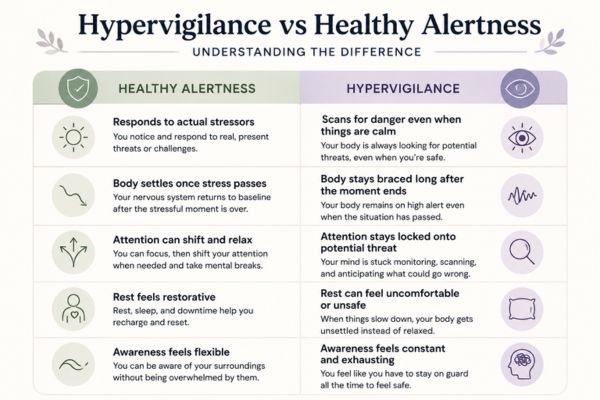
The difference between ordinary stress and hypervigilance is usually persistence — the nervous system stays activated long after the original stressor has passed.
| Healthy Alertness | Hypervigilance |
|---|---|
| Responds to actual stressors | Scans for danger even when things are calm |
| Body settles once stress passes | Body stays braced long after the moment ends |
| Attention can shift and relax | Attention stays locked onto potential threat |
| Rest feels restorative | Rest can feel uncomfortable or unsafe |
| Awareness feels flexible | Awareness feels constant and exhausting |
According to Polyvagal Theory, developed by Dr. Stephen Porges, the nervous system uses a process called neuroception — a below-conscious scanning of the environment for cues of safety or danger. When neuroception has been shaped by trauma or chronic stress, it becomes biased toward threat detection, keeping the system in chronic defensive activation even in objectively safe contexts.
In a childhood home where moods shifted without warning, in a relationship where conflict came out of nowhere, or during a period of sustained stress your system had no way to recover from — your nervous system learned something very specific: the world requires vigilance. And it delivered. It kept you one step ahead. It helped you read the room, anticipate the shift, stay safe.
That learning stays with you long after the circumstances shift. The nervous system is a survival system, and survival systems update through experience — through repeated evidence, felt in the body, that safety is real and that it lasts. That evidence takes time to accumulate. And this is important to remember: it accumulates in the body, not the mind.
In my West Los Angeles practice, this is one of the patterns I sit with most consistently. And every single time, the hypervigilance makes complete sense when we look at the history behind it. The nervous system learned exactly what it needed to learn. The work is in helping it learn something new.
Working with a somatic therapist can help your nervous system build real evidence of safety — not just understanding it, but feeling it.
If you’re based in Los Angeles or anywhere in California, Cheryl Groskopf, LMFT, LPCC offers somatic therapy, trauma therapy, and anxiety therapy in person and via telehealth.
Hypervigilance rarely stays contained to one area of life. It travels with you — into your relationships, your workplace, and even your quietest moments at home.
In relationships, it can look like reading someone’s tone before they have finished their sentence. Bracing for conflict that never comes. Feeling a wave of anxiety when a partner goes quiet or doesn’t text back, even briefly. Replaying conversations afterward, wondering if you said something wrong, sounded weird, or missed a shift in someone’s tone.
For many people carrying hypervigilance, closeness itself can feel activating — because intimacy requires letting your guard down, and the nervous system has learned that letting your guard down carries risk.
At work, it shows up as an exhausting over-attentiveness to the room — tracking who seems frustrated, who seems quiet, what the shift in energy means. Constantly trying to figure out whether someone is upset with you can become so automatic you don’t even realize you’re doing it.
It can also look like difficulty concentrating because the threat-detection system is running in the background, taking up bandwidth that concentration needs. Sometimes even a simple email notification or Slack message can trigger a disproportionate stress response because the body is already braced for something to go wrong.
For many people, hypervigilance shows up most strongly during quiet moments. The second things slow down, the body ramps back up. Some people notice they suddenly feel anxious while resting, lying in bed, taking a vacation, or finally having nothing to do.
The nervous system has spent so long equating alertness with safety that calmness and quiet can initially feel unfamiliar — sometimes even unsafe.
And in the body, over time, the cost accumulates. Chronic tension. Disrupted sleep. Fatigue that doesn’t feel better no matter how much rest you get. Many clients who come to me describing burnout and nervous system exhaustion are, at the nervous system level, running on chronic hyperarousal that has finally run out of fuel. The distinction matters — because the body needs more than rest: it needs to learn that rest is safe.

Hypervigilance does not always look visibly anxious. Some of the most hypervigilant people I work with are incredibly high-functioning. They are the people anticipating everyone else’s needs before anyone asks. The people reading subtle tone shifts immediately. The people who seem calm externally while their body is tracking ten things at once internally.
Sometimes hypervigilance looks like over-preparing. Over-explaining. Struggling to fully relax around other people. Feeling responsible for the emotional tone in the room. Being the person who notices every small change in someone’s mood while simultaneously ignoring their own exhaustion.
Many people carrying hypervigilance were rewarded for it early in life. They were called mature, responsible, perceptive, easy, self-aware. But underneath that adaptability is often a nervous system that learned staying emotionally alert helped prevent conflict, rejection, unpredictability, or emotional disconnection.
Over time, that constant monitoring becomes exhausting. The body was never meant to stay in continuous threat tracking for years at a time.
Hypervigilance is not something most people consciously choose to experience. By the time someone notices they’re constantly scanning, bracing, overthinking tone, or struggling to relax, the pattern has usually been running automatically for years.
It was learned before language, often before memory. And because it lives in the body’s automatic responses, aka in the nervous system’s threat-detection patterns, the most direct path toward healing tends to be body-based.
Somatic therapy works at the level where hypervigilance actually lives — through sensation, breath, posture, and nervous system state — rather than through insight or understanding alone. Understanding why you’re hypervigilant can be deeply valuable. And the body still needs its own evidence. Its own repeated experience of safety, felt from the inside, before it begins to update what it knows.
In session, I move slowly with clients carrying hypervigilance. We build what’s called a window of tolerance — the capacity to stay present with sensation without tipping into overwhelm or shutdown. We accumulate evidence, moment by moment, that this space is safe, that this connection is safe, that it’s possible to soften without something going wrong.
For hypervigilance rooted in early relational wounds, this work often includes attachment-focused therapy — because the nervous system’s threat patterns were often shaped in relationship, and they tend to heal in relationship too. For hypervigilance connected to specific traumatic events or experiences, trauma therapy provides the pacing and structure the nervous system needs. And for those carrying longer developmental patterns, the work often connects directly to complex PTSD treatment.
The research on nervous system adaptability is clear — the same neurological flexibility that allowed your system to learn hypervigilance allows it to learn something new. Nervous systems change through repetition, consistency, and lived experience — not through forcing yourself to calm down.
That is the work. And it is absolutely possible for the body to stop feeling like it has to stay on guard all the time.
Hypervigilance can become difficult to manage when the nervous system rarely feels settled, even during safe or calm moments. Over time, constant alertness can start affecting sleep, concentration, relationships, physical health, emotional regulation, work performance, and the ability to fully rest.
Many people seek support when they notice they are:
If hypervigilance is interfering with your daily life, relationships, or ability to feel calm in your own body, working with a trauma-informed mental health professional can help.
If you’ve spent years feeling constantly on edge, overaware of other people’s moods, unable to fully relax, or exhausted from always staying mentally “on,” hypervigilance is workable. The nervous system can learn something different with the right support and pacing.
In my Los Angeles practice, I work with high-functioning adults experiencing anxiety, trauma responses, chronic nervous system activation, and attachment-related hypervigilance through somatic therapy, trauma therapy, and attachment-focused work. I also work with clients throughout California via telehealth.
Hypervigilance symptoms include constantly scanning for danger, feeling on edge even when nothing is wrong, startling easily, difficulty relaxing, overanalyzing conversations, trouble sleeping, muscle tension, and feeling mentally alert even when physically exhausted. Many people also notice themselves automatically tracking other people’s tone, mood, or facial expressions throughout the day.
Anxiety usually shows up as worried thoughts, fear about the future, or worst-case-scenario thinking. Hypervigilance is more body-based. It’s a nervous system state where the body stays stuck in threat detection, constantly scanning for danger even in safe environments. The two often overlap, but hypervigilance tends to feel more automatic, physical, and difficult to fully “turn off.”
In relationships, hypervigilance can look like overanalyzing tone shifts, bracing for conflict, replaying conversations afterward, constantly checking whether someone is upset, or struggling to fully relax around another person. Many people with hypervigilance become highly attuned to emotional changes because their nervous system learned that staying alert helped them stay emotionally safe or connected
Disclaimer
This post is for educational purposes and is not a substitute for professional mental health care. If you or someone you know is in crisis, support is available — call or text 988 to reach the Suicide and Crisis Lifeline, available 24/7.
Cheryl Groskopf, LMFT, LPCC is a licensed Marriage and Family Therapist and Professional Clinical Counselor based in Los Angeles, California. She is also author of The Somatic Healing Workbook: 100 Body-Based Exercises for Stress Management and Nervous System Regulation. Cheryl specializes in trauma therapy and anxiety therapy, helping high-functioning adults heal nervous system patterns rooted in trauma, chronic stress, and early attachment wounds. Her approach integrates somatic therapy, Internal Family Systems (IFS), and polyvagal-informed care. Cheryl has been featured in Time, Mindbodygreen, HuffPost, Parade, Verywell Mind, and Newsweek. She serves clients in Silver Lake, Echo Park, the Westside, and throughout California via telehealth at evolutiontohealing.com.