
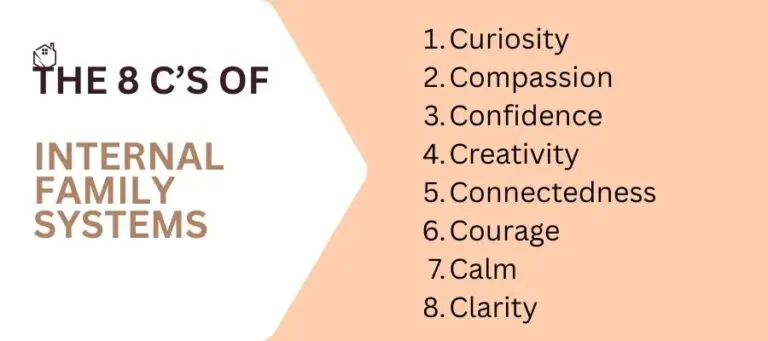
The 8 C’s are what start to show up when your system feels safe again – calm, clarity, compassion, curiosity, confidence, courage, creativity, and connectedness. They’re not traits you perform, they’re who you already are underneath the stress. For the full picture of how this happens in session, see this guide on what IFS therapy actually is.

I’m a dual-licensed therapist in Los Angeles who specializes in anxiety therapy, trauma, somatic work, IFS, and attachment repair. I’ve been featured in TIME Magazine, HuffPost, Verywell Mind, and other major outlets for sharing honest, human insights about what real healing actually looks like.
If you’ve ever wondered what being “in Self” actually means, the 8 C’s of Internal Family Systems (IFS) therapy can help it finally make sense.
These eight qualities — Curiosity, Compassion, Confidence, Creativity, Connectedness, Courage, Calm, and Clarity — come from our own Self-Energy. They’re what naturally show up when your protective parts loosen and your core Self gets to lead. In real life, it doesn’t look shiny. It looks like your breath settling mid-panic. Saying what you mean without spiraling. Letting someone close without performing.
As a therapist who specializes in IFS and somatic work, I work with clients all over Los Angeles — from the Westside to Hollywood to the Valley — who seem composed on the outside but feel like they’re bracing inside. This guide walks through each of the 8 C’s the way they actually show up in therapy, as nervous system states you can feel.
Curiosity is usually the first sign you’re in Self. It’s not big or flashy — it’s just a quiet wondering: “What part of me feels like I did something wrong?” instead of “What’s wrong with me?”
If you grew up where asking questions got you criticized or shut down, curiosity can feel dangerous. Trauma teaches parts to push you into performance or perfectionism instead of pausing. In Los Angeles especially, where the pressure to perform is constant, curiosity often gets buried under overthinking.
According to the IFS Institute, curiosity is often the very first quality that signals your protective parts are stepping back and your core Self is starting to lead.
Why it works: This shows your system that curiosity is safe — slow, non-judging, steady.
Compassion in IFS isn’t pity or problem-solving. It’s what shows up when you stop trying to change a part and just stay with it.
It feels like warmth in your chest, or the pressure to perform dropping for a second. It’s the sense that nothing inside you is “too much.”
This is often the turning point in my approach to IFS therapy: when a part finally feels your compassion, it starts to trust you enough to soften.
Why it works: Compassion is what lets your parts feel safe enough to soften — which is what actually creates change.
Clarity isn’t loud. It’s quiet — like static going out of the air. Your thoughts slow down enough to see what’s actually there.
If you grew up in chaos, your system might link “knowing what you feel” with danger or fallout — so parts blur things on purpose. Clients often tell me they analyze everything because pausing to feel would drop them into grief.
Why it works: Clarity comes from quieting the noise — not forcing an answer.
Confidence from Self isn’t loud or hyped. It’s settled. You speak without rushing, pause without panic, and stay with yourself while you talk.
If confidence once got you called arrogant or “too much,” your system may have buried it. Many high-achievers here in Los Angeles rehearse everything five times or downplay wins just to feel safe.
Why it works: Confidence grows when your system has proof it’s safe to be seen.

Creativity shows up when your nervous system has enough space to imagine something new.
Many high-functioning clients here feel “blank” when they try to be creative — not from lack of ideas, but because their system still thinks it’s unsafe to play.
Research from the American Psychological Association shows how chronic stress blocks creativity — which is why building nervous system safety is essential. When your body finally leaves survival mode, that flexibility often comes back quickly, and somatic therapy can help unlock that.
Why it works: Creativity returns when your body stops bracing for failure.
Connectedness is when your system stops scanning for danger long enough to let someone in.
Clients often notice it in small flashes: laughing without self-checking, or walking down a crowded LA street without feeling on display. It’s not dramatic. It’s just safe-enough closeness.
Try This Practice
Why it works: Connection builds when you stay with yourself while being with others.
Courage isn’t the absence of fear — it’s fear quieting just enough that you can move with it.
Clients are often surprised it doesn’t feel “brave.” It feels shaky, messy, real. But they notice this: they don’t abandon themselves while doing the scary thing.
Why it works: Courage builds when your system learns fear doesn’t mean stop — it means “hold me while we go.”
Calm isn’t zoning out. It’s when your body stops preparing for impact but stays present.
If you grew up in chaos, stillness might still feel unsafe. Many of my high-functioning clients here in Los Angeles only slow down when sick — because their system won’t let them on purpose.
This is often where nervous system regulation through somatic therapy becomes life-changing — teaching your body that stillness can be safe, not threatening.
Why it works: Calm happens when your body gets proof the moment is safe.

Learning the 8 C’s of IFS isn’t about becoming an ideal version of yourself. It’s about noticing what Self already feels like — and letting it lead more often.
They usually show up in flashes: a moment of calm in the middle of panic, or one clear thought after weeks of noise. Those moments matter. They build trust with your nervous system — proof that you can hold what comes up without going under.
If you’re ready to explore this work more deeply, you can learn more about my approach to IFS therapy here in Los Angeles. You don’t have to do this alone — and you don’t have to keep doing it from survival mode.

Cheryl Groskopf, LMFT, LPCC is a dual-licensed therapist based in Los Angeles specializing in anxiety, trauma, somatic therapy, attachment repair, and parts work using IFS.
Cheryl is known for her direct, neuroscience-informed approach that blends emotional safety with practical nervous system tools.
She helps high-functioning, people-pleasing clients build a relationship with their inner world that actually sticks.
She’s been featured as a mental health expert in outlets including:
They’re qualities that naturally show up when your protective parts start to relax: Curiosity, Compassion, Confidence, Creativity, Connectedness, Courage, Calm, and Clarity.
They’re not goals to chase — they’re signs your nervous system feels safe enough to soften.
Because your system learned to survive, not to stay open.
If your body still expects danger, it won’t risk qualities like curiosity or calm — it’ll default to bracing, performing, or shutting down. That’s not resistance. It’s protection.
Yes — by helping your parts feel safe enough to step back. Therapy gives you space to slow down, notice which part is leading, and start trusting your Self to handle what comes up.
That trust builds gradually, then becomes your default.
I’m based in Los Angeles and work with clients all over California through telehealth.
If you’re ready to explore this work more deeply, you can learn more about my approach to “parts work” therapy in Los Angeles.
I’m based in the Greater Los Angeles area and work with adults from all over — including West LA, Hollywood, and Pasadena. I see clients all over California through telehealth.
