
By Cheryl Groskopf, LMFT, LPCC, a trauma and attachment therapist, author of The Somatic Healing Workbook, and expert source for TIME, HuffPost, and ABC News.
Last Updated October 2026
Talking about hard things is part of being close to people. We’re supposed to lean on each other when life feels overwhelming. But there’s a difference between letting someone into what you’re feeling vs. making them responsible for helping you get out of that feeling.
That difference is at the center of trauma dumping.
As a trauma therapist in Los Angeles, I spend my days helping people understand what their bodies are reaching for when emotions feel overwhelming, and I recently spoke with TIME about trauma dumping and why I think we’ve gotten a little too focused on how much someone shares.
What matters more is what the conversation is being asked to do.
Trauma dumping happens when another person becomes your primary way of regulating overwhelming feelings without enough awareness of their capacity, consent, or experience. The content or intensity of the conversation doesn’t define trauma dumping. The function of the conversation does: what you need from the other person and the role they’re being asked to play in helping you feel better.
You might be talking about a breakup, a fight with your mom, something that happened at work, or a genuinely traumatic experience. The subject alone doesn’t tell us whether you’re trauma dumping.
I pay more attention to what’s happening between the two people.
Are you trying to feel understood, or do you need this person to make the feeling go away? Can they respond imperfectly without you becoming more distressed? Are you aware of whether they have the capacity to listen? Is there still another person in the conversation, or has their role slowly become calming you down?
One really intense conversation is not the problem. We’re human. Sometimes we fall apart. Sometimes we need to tell the same story three times. Sometimes a friend needs way more from us than usual, and next month we might need the same thing from them.
I’m much more interested in the pattern.
When one person repeatedly becomes the place you go to make overwhelming feelings stop, emotional support can slowly turn into emotional responsibility. One person gets relief. The other person increasingly feels responsible for creating it.
The difference between venting and trauma dumping comes down to what the conversation is being asked to do. Healthy venting still makes room for the other person. Trauma dumping starts to happen when getting relief becomes so urgent that the listener’s capacity, boundaries, or experience begin to disappear from the conversation.
Someone can cry for an hour about something devastating and still be having a healthy, connected conversation. Someone else can spend 20 minutes talking about a fight with their boss and leave the person listening feeling responsible for fixing their emotional state.
Even when one person is doing most of the talking, there’s still another person in the room.
You notice whether they’re following you. You notice when they get quiet. You care whether they have the emotional capacity to keep listening. They’re allowed to respond imperfectly.
When we’re overwhelmed, our attention naturally narrows. We may become so focused on getting the emotion out that we stop noticing what the conversation is asking of the person on the other side.
The amount of emotion in a conversation tells me very little about whether someone is trauma dumping. Instead, pay attention to whether both people still get to exist inside the conversation.
Consent is one of the clearest differences between healthy venting and trauma dumping.
We usually think about consent in physical relationships, but emotional consent matters too. Active listening certainly isn’t passive because it requires attention, emotional energy, and cognitive work.
Something as simple as:
“Do you have the capacity to talk about something difficult I went through today?”
changes the interaction because now the other person gets a choice.
At the end of the day, many of us have the capability of being present during difficult conversations . What becomes so exhausting is when emotional support starts to feel like an obligation instead of a choice. People tend to burn out from feeling responsible more than they burn out from the content or intensity of the conversation.
| Healthy Venting | Trauma Dumping |
|---|---|
| The listener has a choice | The listener’s capacity is assumed |
| There is awareness of both people | The conversation becomes increasingly one-sided |
| The goal is connection and understanding | The goal increasingly becomes immediate relief |
| The listener can respond imperfectly | The “right” response starts feeling necessary |
| The conversation can move somewhere else | More details keep getting added because relief hasn’t happened |
| Emotional weight is shared | Emotional weight gets transferred |
| Support is part of the relationship | Support starts becoming the relationship |
None of this means every conversation needs to be perfectly reciprocal.
Relationships don’t work like a 50/50 spreadsheet. Sometimes your friend gets 90% of the conversation because their life is falling apart. Sometimes you do.
What’s more telling is what happens over time.
Does this person still feel like someone you’re in a relationship with? Or have they slowly become the person you call whenever you need your nervous system to feel different?
What are the signs of trauma dumping?
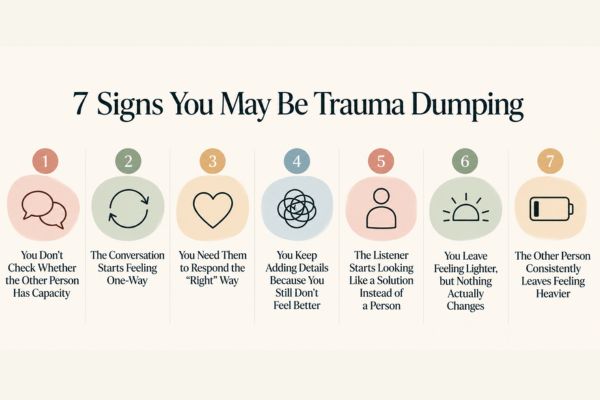
Common signs include sharing without checking whether someone has the capacity to listen, repeatedly having one-sided conversations, needing a specific response to feel better, adding more details when relief doesn’t come, relying on the same person to regulate distress, feeling temporarily better without anything changing, and regularly leaving the listener carrying the emotional weight.
In my Los Angeles therapy practice, one of the first things I pay attention to is whether the other person actually had a choice in entering the conversation.
You don’t need formal permission every time you tell a friend you had a shitty day. But there’s a difference between normal sharing and suddenly handing someone something emotionally heavy without checking whether they have the capacity to hold it.
This is especially important with texts and voice messages. You could be in the middle of work and check your phone on your short break, and all of a sudden have a ten ton trauma dump land on you that you didn’t ask for (nor did you know it was coming). The problem here is that the person receiving it had very little opportunity to consent to what was about to land in their lap.
Ask something like, “I’m having a really hard day and need to vent. Do you have the bandwidth for a voice note?”
People rarely pull away because someone shared too much! They pull away because they stopped feeling like they had a choice in carrying it.
Healthy venting can absolutely be one-sided for a while. If your friend’s dad just died, nobody should be keeping score of who got more airtime.
What I’m looking for is whether awareness of the other person starts disappearing. That’s why the same conversation can feel so different on each side.
One person walks away thinking, God, I really needed that.
The other walks away carrying anxiety, guilt, responsibility, or emotional exhaustion that wasn’t there before.
One of the clearest signs is how much your emotional state depends on the other person’s response.
You need them to reassure you. Agree with you. Tell you that you’re right. Tell you everything is going to be okay.
And if they don’t respond correctly, you leave feeling even more distressed.
The other person may have listened beautifully. But if your nervous system was waiting for a particular response before it was willing to settle, you weren’t only asking them to understand your experience.
You were asking their response to change your emotional state.
Ask yourself:
“Was I hoping they would understand me, or was I hoping they would make this feeling go away?”
You’ve told the story. Still no relief.
Then you remember another detail they need to understand. Still anxious.
Then there’s another piece of context.
When a strategy doesn’t produce the relief our brain expected, we don’t always stop using it. Sometimes we do more of it.
If explaining hasn’t made the feeling go away, your brain may decide you simply haven’t explained it well enough yet.
So you keep talking.
Ask yourself:
“Am I adding information, or am I hoping this detail will finally make me feel different?”
If every new detail feels like relief might be hiding inside it, the conversation may be doing a job conversation alone can’t do.
If the same person repeatedly becomes where you go whenever you’re overwhelmed, both of you can slowly settle into roles.
One person needs relief.
The other becomes expected to provide it.
A useful question is:
“If this person called me right now, would we have anything to talk about besides my problems?”
Relationships need room for distress.
They also need room for silly stories, curiosity, laughter, disagreement, boredom, and knowing each other outside of crisis.
Feeling better after talking to someone is a wonderful thing.
The question is:
What’s different after the conversation?
Maybe you understand yourself better. Maybe you know what you want to do next. Maybe you simply feel supported enough to tolerate something difficult.
Something moved.
But if the only change is that the intensity temporarily dropped, you may need the exact same conversation again when the feeling returns.
Relief and processing aren’t always the same thing.
After venting, ask:
“Besides feeling better, what am I taking with me from this conversation?”
A difficult conversation can be exhausting without being trauma dumping.
If your friend tells you their mom died, of course you may leave feeling sad or emotionally affected. That’s part of caring about another human being.
The pattern I’m interested in is different.
With trauma dumping, emotional weight can start getting relocated.
The speaker leaves calmer. The listener leaves carrying anxiety, guilt, urgency, responsibility, or exhaustion that they weren’t feeling or holding onto before.
Emotional support should help us share emotional weight, not simply move it from one nervous system into another.
People often trauma dump because they’re overwhelmed and their nervous system is looking for relief. Talking to another person can genuinely make us feel better. The pattern becomes a problem when that relief becomes something we repeatedly need another person to create for us.
When you’re emotionally overwhelmed, your brain probably isn’t thinking, How can I completely exhaust my best friend tonight?
You’re trying to feel better.
Your chest feels tight. Your thoughts won’t stop. You’re replaying what happened. You feel an almost physical urgency to call someone and hear that you’re going to be okay.
So you call.
They listen.
Your body settles.
That relief is real.
Humans regulate with other humans. The pattern becomes worth examining when another person stops being one way you move through distress and starts becoming the way you need to make distress stop.
Our brains learn from what works.
If you feel overwhelmed, call your friend, receive reassurance, and immediately feel calmer, your brain learns:
When I feel like this, talking to this person helps.
But feeling better temporarily doesn’t necessarily mean whatever created the distress has been processed.
You can feel calmer without becoming more able to tolerate uncertainty.
You can feel reassured without trusting yourself more.
So when distress returns, your brain reaches for what worked last time.
Call. Explain. Get reassurance. Feel better. Repeat.
Anxiety loves certainty.
Do you think they’re mad at me?
Do you think I screwed this up?
What would you do?
Do you think everything will be okay?
There’s nothing unusual about asking those questions sometimes.
But reassurance can give us certainty without helping us build tolerance for uncertainty.
For a moment, we feel safe.
Then another doubt appears.
And we need another answer. In the anxiety therapy that I do in my LA office, we work on building your capacity to sit with uncertainty, so your body can settle on its own and reassurance becomes one option among many.
If you recognized yourself in a few of these signs, you’re already doing the kind of noticing that makes change possible, and understanding how these patterns form in close relationships is a big part of the work I do in attachment therapy in my Los Angeles practice.
Trauma dumping is not automatically manipulative. Most people who trauma dump aren’t consciously trying to overwhelm or control someone. They’re overwhelmed themselves and trying to find relief.
But behavior doesn’t have to be intentional to create pressure:
You can care deeply about someone and still overwhelm them.
You can have no intention of crossing a boundary and still cross one.
You can be genuinely suffering and still ask more of another person than they have the capacity to give.
Two things can be true:
Your distress is real.
The impact of how you’re sharing it is real too.
I become more concerned when distress starts limiting the other person’s ability to have boundaries.
If someone says they can’t talk and you repeatedly call anyway, or saying “I don’t have capacity” leads to guilt, punishment, threats, or accusations that they don’t care, we’re dealing with something beyond simply needing support.
Compassion for why a behavior happens and boundaries around its impact can exist at the same time.

Trauma dumping is not a clinical diagnosis or one of the traditional trauma responses like fight, flight, freeze, or fawn.
But trauma, anxiety, attachment experiences, and difficulty regulating overwhelming emotions can contribute to why someone develops a pattern of relying heavily on other people for relief.
I’m less interested in labeling trauma dumping itself as a trauma response and more interested in asking:
“What did my nervous system learn I needed to do to feel safe with another person?”
Maybe support was inconsistent, so when someone was available, you learned to hold tightly to the connection.
Maybe your feelings were dismissed until they became big enough that somebody finally paid attention.
Maybe reassurance became important because relationships felt unpredictable. When experiences like these repeat throughout childhood, they can shape your body’s sense of safety in lasting ways, which is exactly what we explore together in complex PTSD therapy.
Those strategies can make complete sense in context and still create problems now. Understanding why a pattern developed gives you more options for what you do with it next.
Most relationships naturally move back and forth between giving and receiving support.
Sometimes you’re the mess.
Sometimes I’m the mess.
Sometimes neither of us is the mess and we’re talking about what we’re having for dinner.
When trauma dumping becomes a pattern, those roles can become fixed.
One person repeatedly brings the distress. The other reassures, problem-solves, talks them down, or helps them make sense of it.
There’s a difference between feeling safe enough to need someone and needing that person to repeatedly make you feel safe.
The listener may keep answering.
Keep reassuring.
Keep saying, “Of course you can call me.”
From the outside, it looks like consent.
Internally, they may be getting increasingly depleted and resentful.
Eventually they pull away, stop answering, or explode after months of saying everything was fine.
The person sharing is responsible for noticing their impact. The listener is also responsible for communicating limits instead of expecting someone else to magically know them.
Healthy emotional boundaries require participation from both people.
Think about what makes a relationship feel like a relationship.
You laugh. Gossip. Tell stupid stories. Disagree. Send memes. Ask about each other. Have experiences together that have nothing to do with emotional crisis.
When trauma dumping becomes the organizing pattern, that range starts disappearing.
Contact increasingly means distress.
Conversation increasingly means processing.
The relationship becomes:
crisis → reassurance → temporary relief → crisis
Eventually, both people lose something.
How do you stop trauma dumping?
Stopping trauma dumping doesn’t mean you stop talking about hard things or handle everything yourself. The goal is to notice when emotional urgency is taking over, understand what you’re actually asking another person for, and build more than one way to move through distress.
Notice the urgency.
I need to tell someone right now.
I need to know what they think.
I need to know everything is okay.
Before immediately calling or texting, notice what is happening in your body.
Tight chest?
Racing thoughts?
Pacing?
Stomach dropping?
You don’t have to make those sensations disappear.
Just create a little space between feeling the urgency and acting on it. Building this kind of body awareness is at the heart of somatic therapy, and with practice, that little space becomes easier and easier to find.
Ask:
“What am I hoping this conversation will do for me?”
Do you want listening?
Advice?
Help making a decision?
Reassurance?
Or do you desperately want someone to make the feeling stop?
Once you know, you can ask more directly:
“I don’t need advice. I just need someone to listen for a few minutes.”
Or:
“I keep going in circles with this. Can you help me figure out what I’m actually stuck on?”
Try:
“I’m having a rough day. Do you have ten minutes for me to vent?”
Now the person knows what you need, roughly how much you’re asking for, and has an actual opportunity to say no.
And if they say no:
Let them.
A boundary only works if the other person is allowed to have one without being punished for it.
One person cannot be your entire emotional support system.
A friend might help you feel understood.
A therapist might help you understand why the same situations keep activating you.
Writing might organize your thoughts.
Movement might help your body work through activation.
Time might teach you that an emotion can change without anybody doing anything to it.
Different kinds of support do different jobs. Holistic therapy looks at your life this way too, bringing your body, mind, relationships, and daily rhythms together so support can come from many directions at once. The goal is to have more choices for what you do when you need them.

You don’t have to match their urgency. Check whether you have the capacity to listen, decide what support you can realistically offer, and communicate that clearly.
Ask:
“Do I actually have the capacity for this right now?”
Maybe you do.
Great. Listen.
Maybe you have ten minutes but not two hours.
You can say:
“I really want to be here for you, but I don’t have the bandwidth to do this well right now.”
Or:
“I can talk for about 15 minutes, but then I need to get back to what I’m doing.”
You don’t have to guess.
Ask:
“Do you want me to listen, or do you want help figuring out what to do?”
Sometimes we give advice because we’re uncomfortable watching someone struggle. Solving their problem gives us something to do with our own discomfort.
They may need to be witnessed instead.
If someone keeps asking the same question, more reassurance may stop being helpful.
Instead of answering for the sixth time, try:
“I notice I’ve answered this a few times and it doesn’t seem to be making you feel any safer. What feels scary about not knowing right now?”
Now you’re helping them notice their relationship with uncertainty instead of trying to eliminate uncertainty for them.
Don’t wait until six months of resentment explodes out of you.
Try:
“I love you and I want to support you, but I don’t think going through this again tonight is helping either of us.”
Or:
“I don’t have capacity tonight. Can we talk tomorrow?”
You don’t need a courtroom argument proving your boundary is justified.
You don’t have to absorb someone else’s urgency just because they’re feeling it.
Maybe the conversation happened three hours ago.
Now you’re regulated enough to look back and think:
Oh shit. I think I put way too much on them.
You don’t need to pretend it didn’t happen, and you don’t need to turn it into a giant apology that requires the other person to reassure you that you’re not a terrible friend.
Repair can be simple.
You might say:
“I realized after our conversation that I put a lot on you without checking whether you had capacity for it. I’m sorry. You don’t need to reassure me about it. I just wanted to acknowledge it.”
Then let the repair be about their experience, rather than making them take care of your guilt too.
You can also ask:
“Was there anything about that conversation that felt like too much for you?”
Then listen to the answer.
Maybe they say, “No, I was totally fine.”
Great.
Maybe they tell you they were overwhelmed.
That’s useful information too.
Repair doesn’t require punishing yourself for having needs.
It means being willing to notice your impact, take responsibility for it, and do something differently next time. If a harsh inner critic shows up the moment you realize you overshared, that critic is a part of you working hard to protect your relationships, and getting to know it with curiosity and compassion is a big part of what we do in IFS therapy.
Everybody needs other people.
The goal of emotional health isn’t becoming so perfectly self-regulated that you never call a friend crying again.
But if you regularly feel unable to settle until someone reassures you, find yourself having the same conversations without anything changing, become panicked when people aren’t available, or notice relationships becoming organized around your distress, it may be worth getting curious about what your nervous system is trying to accomplish.
Therapy, such as trauma therapy, can give you somewhere to understand the pattern instead of simply trying to stop the behavior.
Maybe uncertainty feels unbearable.
Maybe another person’s availability has become tied to whether you feel safe in the relationship.
Maybe your body moves into fight, flight, freeze, or fawn before you even understand what triggered it.
Trauma therapy can help with trauma dumping by helping you understand what your body learned to do to feel safe with other people, while building new ways to move through overwhelming feelings. Somatic therapy adds tools for noticing urgency in your body and letting it settle, so reaching out to someone becomes a choice you make with care. I offer both for adults across California, online and in my Los Angeles office, and you can start with a free 15-minute consultation.
If you’re in crisis or having thoughts of harming yourself, call or text 988 to reach the Suicide & Crisis Lifeline
Trauma dumping can be a red flag when it becomes a repeated pattern and the listener’s boundaries stop being respected. One intense conversation is part of being human. The bigger concern is when someone regularly shares heavy emotions without checking your capacity, needs a specific response to feel better, or reacts with guilt or anger when you can’t talk.
When someone is trauma dumping, start by checking your own capacity, then be honest about what you can offer. Try saying, “I want to support you, and I have about 15 minutes right now,” or “Do you want me to listen, or help you figure out what to do?” Clear, kind limits protect the relationship for both of you.
When a parent trauma dumps on a child, the child often becomes the parent’s emotional caretaker. Signs include a child who acts as a confidant, closely tracks a parent’s moods, comforts the adult, or hides their own feelings. Over time, this can lead to parentification, anxiety, people-pleasing, and difficulty trusting their own needs as adults.
You can stop someone from trauma dumping by setting a clear, kind boundary early and repeating it consistently. Try, “I care about you, and I don’t have the capacity for this tonight. Can we talk tomorrow?” You can also suggest other sources of support, like a therapist, and gently redirect conversations that keep circling the same distress.
Cheryl Groskopf, LMFT, LPCC, is a licensed trauma, attachment, and somatic therapist in Los Angeles and the author of The Somatic Healing Workbook (Blue Star Press / Penguin Random House). She helps high-functioning adults with anxiety, attachment patterns, and trauma feel safer in their bodies and relationships, and she works online with clients across California. Her expertise has been featured in TIME, HuffPost, ABC News, Cosmopolitan, and Good Morning America. California licenses: LMFT 122530, LPCC 10096.