
Fawn Response to Narcissistic Abuse: 9 Signs, Why It Happens, and How to Heal
Maybe you've been in a relationship where you could tell something was wrong just by the way your partner walked into the room.
You noticed their tone change, their facial expression, or how long it took them to respond to your text. And before they even said anything, you were already trying to figure out what you could do to make things better.
Maybe you started acting extra cheerful. Maybe you decided that whatever you wanted to bring up could wait. Or maybe you found yourself apologizing for something you weren't even sure you'd done.
Eventually, you got so used to paying attention to their feelings, moods, and reactions that you started losing sight of your own wants, needs, and preferences.
This is one way the fawn response to narcissistic abuse can develop.
And here's what I find especially interesting about fawning: you can become incredibly good at understanding what everyone else needs while having absolutely no idea what you need.
In my work providing somatic therapy in Los Angeles, I often see how these patterns continue long after someone has left an unhealthy relationship. They understand intellectually that they can speak up, disagree, or disappoint someone. But the moment another person seems upset, their body reacts as though something bad is about to happen.
Understanding why this happens is an important part of changing it.
What Is the Fawn Response to Narcissistic Abuse?
The fawn response to narcissistic abuse is a protective response in which someone tries to prevent conflict, rejection, or emotional harm by people pleasing, agreeing with, or accommodating another person. It often develops when expressing your own needs has repeatedly led to criticism, anger, withdrawal, or punishment.
You might apologize to keep someone from getting angry, agree to something you don't want, or feel responsible for making sure another person is happy.
Over time, these behaviors can become automatic.
The term fawn response was popularized by trauma therapist Pete Walker, who described it as a way people respond to perceived threats through appeasement.
I explore the broader pattern in my guide to the fawn trauma response. Here, we're focusing specifically on what happens when someone learns to manage an emotionally abusive person's reactions to protect themselves.
One important distinction: narcissistic abuse is a commonly used term for emotionally abusive patterns involving manipulation, control, humiliation, or blame. Someone does not need a diagnosis of narcissistic personality disorder for their behavior to be harmful.
9 Signs of the Fawn Response to Narcissistic Abuse
Fawning can become so automatic that you may not even recognize when you're doing it.
You might think you're being considerate, avoiding unnecessary arguments, or trying to be a good partner.
But when your decisions are consistently shaped by how someone else might react, it's worth paying attention to what's happening.
1. You apologize even when you haven't done anything wrong
Your partner makes a joke about something you're insecure about in front of friends. Later, you tell them it embarrassed you.
They respond by saying you're too sensitive, that you can't take a joke, or that you've ruined the evening.
Twenty minutes later, you're the one apologizing.
And somehow, the conversation has shifted from how they treated you to how badly you handled their joke.
When this happens repeatedly, you may start apologizing the moment you notice someone becoming upset.
Your brain has learned that taking responsibility, even when something isn't your responsibility, can help end an uncomfortable interaction.
2. You constantly monitor their mood
You can tell when something is wrong before your partner says a word.
Maybe their texts are shorter than usual. Maybe they seem unusually quiet. Maybe you notice the expression on their face when you mention spending time with friends.
And suddenly, your attention shifts toward figuring out what's happening with them.
This is connected to hypervigilance, which involves becoming highly alert to possible signs of danger.
When you've experienced unpredictable reactions, your nervous system can learn to pay close attention to subtle changes in someone's behavior.
The exhausting part is that you may continue monitoring them even when nothing is happening.
3. You change your opinions depending on who you're with
You tell your partner you enjoyed spending time with a particular friend.
They make a face and say, "Really? I can't stand her."
Suddenly, you're explaining that she's actually been annoying you lately, too.
Later, you wonder why you said that. You genuinely like your friend.
This can happen when disagreeing has repeatedly resulted in criticism, arguments, or rejection.
You begin adjusting your opinions to avoid creating tension.
Over time, you may become so accustomed to considering everyone else's preferences that you struggle to identify your own.
4. You feel responsible for managing their emotions
Your partner comes home upset about work.
You immediately start thinking about what you can do to make their evening better.
You cancel your plans, change what you're doing, or avoid mentioning something that might upset them further.
And if they're still in a bad mood, you feel like you've failed somehow.
This is especially common when you've learned that another person's emotional state determines how the rest of your day will go.
You start taking responsibility for feelings that belong to someone else.
Eventually, their emotional needs begin taking priority over your own, even when you're exhausted or overwhelmed.
5. You overthink how to say something simple
You want to tell your partner that you're staying home tonight.
But instead of sending the text, you spend twenty minutes rewriting it.
You add an explanation. Then another explanation. Then something affectionate so they won't think you're upset.
You read it again, wondering whether it sounds selfish.
By the time you're finished, you've put more effort into managing their potential reaction than into deciding what you actually want.
This is something I frequently see with people who struggle with anxiety and people-pleasing.
Sometimes the overthinking is an attempt to find the perfect combination of words that will prevent someone from becoming disappointed or angry.
And when you've been punished for expressing yourself, that fear can make a lot of sense.
6. You struggle to maintain boundaries when someone gets upset
You tell your partner you can't lend them money.
They become quiet and say something like, "Wow. I guess I know how much you care about me."
You immediately feel guilty.
You start explaining your finances, reassuring them that you love them, and eventually reconsidering your decision.
What started as a reasonable financial boundary has become a conversation about proving your love.
When someone repeatedly responds to your boundaries with guilt, anger, or emotional withdrawal, you may begin associating boundaries with the possibility of losing connection.
Eventually, giving in can feel easier than tolerating their reaction.
7. You end up comforting the person who hurt you
You tell your partner that something they said really hurt your feelings.
They respond with, "I guess I'm just a terrible person. Nothing I do is ever good enough for you."
Now you're reassuring them.
You're telling them they're a good person, explaining that you love them, and trying to make sure they don't feel bad.
Meanwhile, the original reason you brought up the conversation has completely disappeared.
When this becomes a pattern, you may stop bringing up things that bother you because you already know how much emotional work will follow.
Your own hurt gets pushed aside while you focus on helping the other person feel better.
8. You feel immediate relief when they're happy with you again
You've been anxious all day because your partner seemed upset that morning.
You've checked your phone repeatedly, replayed your last conversation, and wondered whether you should reach out.
Then they send you a funny video or an affectionate text.
And suddenly, you can relax.
Your shoulders drop. Your stomach settles. You can finally concentrate on something else.
This kind of relief can become incredibly powerful.
When your sense of safety depends on another person's approval, even a small sign of affection can have an enormous effect on how you feel.
It can also make it harder to address unresolved problems because you're afraid of disrupting the connection you've just gotten back.
9. You make decisions based on what will upset them the least
Someone asks what you want for dinner.
You immediately start considering what everyone else might want.
You remember that your partner complained about the restaurant you chose last time. You think about how tired they are and whether they'll be annoyed about parking.
Eventually, you say, "I'm good with whatever."
And maybe you genuinely don't know what you want anymore.
When you've spent years prioritizing other people's reactions, your attention becomes so externally focused that you lose touch with your own preferences.
You become incredibly skilled at figuring out what will make everyone else comfortable while rarely stopping to consider what would make you comfortable.
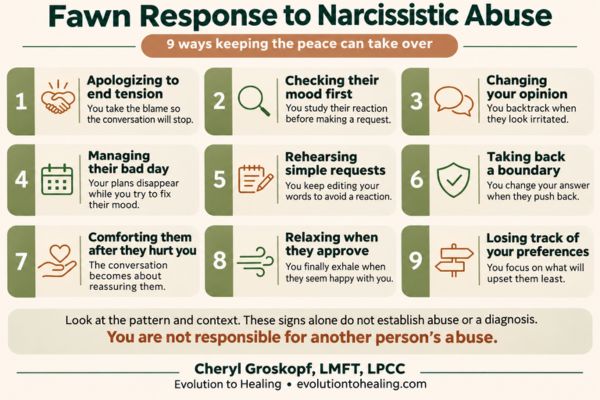
The fawn response can affect how you communicate, make decisions, set boundaries, and experience relationships.
What Does Fawning Feel Like in Your Body?
Fawning can also involve physical changes that happen before you're consciously aware of what you're doing.
You might notice:
- Your stomach tightening when someone sounds annoyed.
- Your throat feeling tight when you try to disagree.
- Smiling or laughing while discussing something that actually upset you.
- Talking faster and explaining yourself more than usual.
- Feeling physically relieved when someone reassures you that everything is okay.
- Feeling angry or resentful hours after you've agreed to something.
These sensations can have many causes, so they don't automatically mean you're fawning.
What matters is understanding what was happening when they appeared and how they influenced your response.
For example, you might notice your chest tightening when someone asks you for a favor. Before you've even considered whether you have time, you hear yourself saying yes.
That moment can tell us a lot about how your nervous system has learned to respond to other people's needs.
Why Does Narcissistic Abuse Cause the Fawn Response?
Repeated emotional abuse can teach your brain and nervous system that keeping another person happy reduces the likelihood of conflict, criticism, or rejection.
The more often this happens, the more automatic the response can become.
There are several psychological processes involved.
Your attachment system wants to preserve connection
Humans depend on relationships for safety, connection, and support.
From infancy, we learn about relationships through the way caregivers respond to our needs.
When the people we depend on are unpredictable, dismissive, or frightening, we may develop strategies to maintain closeness and reduce conflict.
For some people, that means becoming especially attentive to what others want.
And this can become particularly complicated in an emotionally abusive romantic relationship.
You may love your partner, depend on them emotionally or financially, and fear their reactions at the same time.
Your attachment system may be pushing you toward connection while your nervous system is responding to the possibility of danger.
That conflict can make appeasing the other person feel like the safest available response.
Your brain learns from what brings relief
Imagine that your partner becomes angry whenever you spend time with a particular friend.
Eventually, you start declining invitations.
When you stay home, your partner is affectionate and the evening goes smoothly.
Your brain begins connecting the decision to stay home with the relief that follows.
This is an example of negative reinforcement: a behavior becomes more likely because it reduces or removes something unpleasant.
In this case, accommodating your partner reduces the immediate tension.
Over time, you may start making these adjustments automatically, even before they express an opinion.
Unpredictable affection can strengthen the pattern
Some emotionally abusive relationships involve periods of affection followed by criticism, withdrawal, or conflict.
One day your partner is affectionate and attentive. The next, they seem irritated by everything you do.
You begin trying to understand what changed.
Maybe you said something wrong. Maybe you weren't affectionate enough. Maybe you need to be more patient.
You start searching for ways to bring back the connection.
Unpredictable responses can make people more persistent in trying to obtain reassurance or approval. In an abusive relationship, that uncertainty can contribute to a powerful cycle of anxiety, appeasement, and relief.
You may have learned these behaviors in childhood
Maybe you grew up with a parent whose mood affected everyone in the house.
You learned when it was okay to ask for something, when to stay quiet, and how to avoid making a difficult situation worse.
Perhaps you were praised for being mature, independent, or the child who never caused problems.
Meanwhile, you were learning to manage your own feelings privately so you wouldn't create additional stress for the adults around you.
Children adapt to their environments. When expressing needs leads to criticism, rejection, or emotional withdrawal, some children learn that being agreeable helps preserve connection.
These patterns can continue into adulthood, especially in relationships that recreate familiar emotional dynamics.
I explore this further in my article about growing up with narcissistic parents.
And it's important to remember that fawning can also develop in an abusive adult relationship, even when someone had a supportive childhood.
Why Does the Fawn Response Continue After Narcissistic Abuse Ends?
The fawn response can continue after an abusive relationship because your brain and nervous system have learned to anticipate certain reactions. Even when your circumstances change, familiar situations may still trigger the urge to apologize, accommodate, or seek reassurance.
This is one of the most frustrating parts of healing for many people.
You might understand exactly why you developed these behaviors and still find yourself repeating them.
Your brain uses past experiences to predict what happens next
Your brain constantly uses previous experiences to anticipate what might happen.
This helps you recognize patterns and respond quickly.
But after repeated emotional abuse, your brain may begin predicting danger in situations that resemble what you've experienced before.
For example, your former partner became angry whenever you wanted to spend time with friends.
Now you're dating someone who encourages you to have your own friendships.
You know they're supportive.
Yet you still feel compelled to explain exactly where you're going, who will be there, and when you'll return.
Your brain is responding to a familiar situation using information it learned from a previous relationship.
Intellectual understanding doesn't automatically change a learned response
This is something I talk about frequently in therapy.
You can understand that your current partner is safe. You can recognize that your friend isn't going to abandon you because you declined an invitation.
And you can still feel anxious when you disappoint them.
That's because many of our emotional and physiological responses happen automatically, before we've had time to consciously evaluate a situation.
The nervous system learns through repeated experiences, and changing those responses often takes more than understanding where they came from.
We want to help your brain and body develop new expectations through experiences where expressing yourself is met with respect and emotional safety.
You may become your own harshest critic
After years of criticism, you may start anticipating what someone else would say about you.
You make a small mistake at work and immediately start calling yourself incompetent.
You disagree with a friend and spend the evening wondering whether you were selfish.
You may even criticize yourself before anyone else has the opportunity.
From an IFS therapy perspective, we might explore whether this critical part developed as an attempt to prevent future rejection or humiliation.
If you can catch your own mistakes first, perhaps you can avoid someone else's anger.
That strategy may have developed for a reason, even though it now contributes to your anxiety and shame.
Healthy relationships can initially feel unfamiliar
When you're used to monitoring someone's moods, a relationship where you can openly express yourself may feel unfamiliar.
You might wonder whether someone is secretly upset when they say they're fine.
You may feel uncomfortable when a partner gives you space instead of demanding an explanation.
You might even feel anxious when things are going well because you're waiting for something to change.
These experiences can be particularly relevant for people working through insecure attachment patterns.
Healing involves developing a greater ability to recognize safety, tolerate normal disagreements, and remain connected to your own needs within relationships.
For people experiencing persistent trauma symptoms, complex PTSD therapy may also help address the effects of prolonged emotional abuse.

Fawn Response vs. People-Pleasing: What's the Difference?
People-pleasing involves prioritizing other people's approval, comfort, or preferences, often at your own expense. Fawning describes appeasing someone in response to a perceived threat. These patterns can overlap, and the same behavior may involve both a desire for approval and fear of rejection.
For example, imagine your friend asks you to help her move on Saturday.
You already have plans, but you agree anyway.
Maybe you want her to think you're a dependable friend. Maybe you feel guilty disappointing her.
Or maybe the thought of telling her no makes your stomach tighten because you've learned that disappointing people leads to anger, rejection, or punishment.
The behavior looks similar, but the emotional learning behind it may be different.
I discussed the connection between people-pleasing and survival mode in Mindbodygreen.
One useful question to explore is:
What am I afraid will happen if I tell this person what I actually want?
Pay attention to the specific answer.
Are you worried they'll be disappointed? That they'll think you're selfish? That they'll stop talking to you? That they'll become angry or retaliate?
And consider how this person has actually responded to your needs in the past.
This helps you distinguish between expectations learned in earlier relationships and situations where your safety may genuinely be at risk.
You may also recognize similarities with codependent relationship patterns, especially when your emotional well-being becomes heavily dependent on how another person is feeling.
How to Heal the Fawn Response After Narcissistic Abuse
Healing from the fawn response involves learning to recognize automatic appeasing behaviors, reconnecting with your own needs, and gradually developing different ways of responding in relationships.
An important part of this process is understanding that your nervous system needs experiences of safety and choice to develop new patterns.
A note on safety
If you're currently experiencing abuse, your safety comes first. Confronting someone who has threatened or punished you may increase your risk. The National Domestic Violence Hotline offers confidential support and safety planning at 800-799-7233 or by texting START to 88788.
The following practices are intended for situations where expressing yourself is reasonably safe.
1. Identify what you're afraid will happen
Start paying attention to the moments when you feel compelled to agree, apologize, or explain yourself.
Get specific about the reaction you're anticipating.
For example, instead of saying, "I hate conflict," you might recognize:
"I'm afraid that if I tell my friend I can't come, she'll think I'm selfish and stop inviting me."
Now you have something more specific to explore.
Where did you learn to expect that reaction? Has this friend responded that way before? What happens in your body when you imagine disappointing her?
Understanding the fear behind the behavior can help you recognize when you're responding to a current situation and when an earlier experience may be influencing your expectations.
2. Practice giving yourself time before responding
If you tend to agree to things automatically, practice creating a little space between someone's request and your answer.
You might say:
- "Let me check my schedule and get back to you."
- "I need some time to think about that."
- "I'll let you know tomorrow."
This gives you an opportunity to consider your own needs before committing.
And here's something I think is especially important: having an empty calendar doesn't mean you're automatically available.
You may have time to do something and still prefer to spend that time resting, being alone, or doing something else.
Your preferences deserve consideration, too.
3. Notice what happens in your body before you start appeasing
Many people recognize that they've been fawning only after an interaction is over.
They agreed to something, reassured someone, or apologized automatically.
Then, hours later, they realize they were uncomfortable with the entire situation.
One way to start changing this is by getting curious about what happens immediately before the behavior.
Maybe your chest tightens when someone seems disappointed.
Maybe your stomach drops when you hear irritation in their voice.
Maybe you start speaking faster, smiling, or explaining yourself.
These physical cues can help you recognize when your nervous system is becoming activated.
And the earlier you recognize that activation, the more opportunity you may have to respond differently.
Try This: Notice the Urge to Overexplain
Imagine you've told a friend that you can't make dinner.
You've already sent a perfectly reasonable message, but now you're feeling anxious.
You want to send another text explaining how busy you've been, how exhausted you are, and how much you wish you could come.
Before sending it, try this:
- Pause and notice your surroundings. Look around the room and identify a few things you can see.
- Notice any physical tension. Maybe your shoulders are raised, your stomach feels tight, or you're holding your breath. You can skip this step if focusing on your body feels uncomfortable.
- Identify what you're hoping the additional explanation will accomplish. Perhaps you're hoping your friend will reassure you that she isn't upset.
- Look at what you've already communicated. Did you give her the information she needs?
- Decide whether another message is necessary. You can provide more information when it's useful, while also allowing yourself to leave a reasonable explanation as it is.
The goal is to recognize when anxiety is influencing your behavior so you have more choice in how you respond.

For additional nervous system practices, explore my somatic therapy exercises or my book, The Somatic Healing Workbook.
4. Learn to recognize guilt without automatically acting on it
Imagine you tell your sister that you can't host Thanksgiving this year.
She sounds disappointed.
You immediately feel guilty and start reconsidering your decision.
Maybe you could rearrange your schedule. Maybe you could make it work if you pushed yourself a little harder.
Before changing your mind, consider what the guilt is telling you.
Did you break a commitment? Did you treat someone unfairly? Is there something you genuinely need to repair?
Or are you feeling uncomfortable because someone you care about is disappointed?
For people who grew up feeling responsible for other people's emotions, disappointment can trigger a powerful urge to fix things.
Learning to tolerate that discomfort can be an important part of developing healthier boundaries.
5. Practice expressing preferences in safe relationships
Start noticing how often you automatically defer to other people.
Maybe someone asks where you'd like to eat, and you immediately say, "Whatever you want."
Or a friend suggests a movie you're not interested in, and you agree before considering what you'd prefer.
Try giving yourself a moment to think about what you actually want.
Then practice expressing that preference with someone who has demonstrated that they respect your choices.
Pay attention to what happens afterward.
Do you feel guilty? Do you want to take your answer back? Do you start explaining why you chose what you chose?
These reactions can help you understand how deeply the pattern has become ingrained.
Over time, repeated experiences of expressing your needs and having them respected can help your nervous system develop different expectations about relationships.
How Therapy Can Help You Change the Fawn Response
One of the things I find most important about working with fawning is understanding what happens in the moments when you automatically abandon your own needs.
You might come into therapy and tell me about a conversation where you agreed to something you didn't want.
We can slow that interaction down and explore what happened.
What did you notice when the other person seemed disappointed? What were you expecting them to do? What happened in your body right before you changed your answer?
We can also explore what you've learned about relationships throughout your life.
Maybe you grew up believing that expressing anger would make people leave. Maybe you learned that being helpful and agreeable was the best way to receive affection.
And maybe there's a part of you that feels incredibly resentful about how much you've spent your life accommodating everyone else.
Through IFS-informed therapy, we can explore the different parts involved in these patterns, including the part that wants to keep everyone happy and the part that's exhausted from constantly putting itself last.
With somatic work, we can pay attention to how these experiences show up in your nervous system and develop ways to respond with greater awareness and choice.
I also think the therapeutic relationship itself can be an important place to practice.
For example, if I suggest something in session and you automatically agree, we might get curious about that.
You can tell me an exercise feels uncomfortable. You can disagree with my interpretation. You can tell me when something isn't working.
These moments give us opportunities to explore what it feels like to express yourself within a relationship where your needs and preferences matter.
My approach to trauma therapy in Los Angeles combines somatic, attachment-focused, and IFS-informed approaches to help adults work through patterns connected to anxiety, childhood experiences, and emotionally abusive relationships.
I offer online therapy throughout California.
Frequently Asked Questions
Can narcissistic abuse lead to PTSD?
Yes, narcissistic abuse can contribute to PTSD when someone experiences events that meet the criteria for psychological trauma. Prolonged emotional abuse can also lead to chronic anxiety, hypervigilance, shame, and difficulties trusting others. Some people develop symptoms associated with complex PTSD, particularly after repeated experiences of abuse or feeling trapped in an unsafe relationship. Complex PTSD therapy in Los Angeles can help address these lasting effects.
How to recognize narcissistic abuse?
Signs of narcissistic abuse can include manipulation, gaslighting, constant criticism, blame-shifting, emotional withdrawal, and controlling behavior. You might notice yourself constantly monitoring someone's mood, questioning your own memory, or apologizing just to end an argument. Over time, you may become so focused on preventing their negative reactions that you start ignoring your own needs. These behaviors can be emotionally abusive regardless of whether someone has narcissistic personality disorder.
What does fawning look like as a trauma response?
Fawning as a trauma response can look like automatically agreeing with others, apologizing excessively, avoiding conflict, overexplaining yourself, or prioritizing someone else's feelings to prevent anger or rejection. You might smile when you're uncomfortable, change your opinion when someone disagrees, or feel responsible for keeping everyone happy. These behaviors can become automatic when your nervous system has learned that pleasing others helps you avoid conflict or emotional harm.
What are the long-term effects of fawning?
Long-term effects of fawning can include chronic anxiety, emotional exhaustion, resentment, difficulty setting boundaries, and losing touch with your own needs and preferences. You may struggle to make decisions without considering how others will react or feel guilty whenever you disappoint someone. Over time, constantly prioritizing other people's emotions can affect your self-esteem, sense of identity, and ability to feel secure in relationships.
Why do I still fawn after leaving an abusive relationship?
You may continue fawning after leaving an abusive relationship because your brain and nervous system have learned to associate disagreement, boundaries, or disappointing others with danger. Even when you're around supportive people, familiar situations can trigger automatic people-pleasing behaviors. For example, you might overexplain a simple decision because you anticipate criticism that never actually comes. These learned responses can gradually change through repeated experiences of safety and supportive relationships.
Can you stop the fawn response?
Yes, you can change the fawn response by learning to recognize automatic people-pleasing behaviors, reconnecting with your own needs, and practicing boundaries in safe relationships. Because fawning can involve learned nervous system responses, understanding the pattern intellectually may not be enough to change it. Somatic therapy in Los Angeles can help you recognize these responses and develop greater awareness and choice in how you respond to others.

Healing Means Making Room for Your Own Needs
When you've spent years paying attention to what everyone else wants, reconnecting with your own needs can take time.
You may still feel guilty when you say no. You may still worry when someone seems disappointed. You may still catch yourself apologizing or explaining more than you intended.
Those moments can become opportunities to understand what you've learned about relationships and begin developing different responses.
If you're struggling with fawning, people-pleasing, or the effects of emotional abuse, I offer somatic and attachment-focused therapy for adults in Los Angeles and throughout California.
Schedule a Free 15-Minute ConsultationSources and Further Reading
- Pete Walker: Codependency, Trauma and the Fawn Response
- National Domestic Violence Hotline: Emotional Abuse
- National Child Traumatic Stress Network: Complex Trauma
- VA National Center for PTSD
This article is for educational purposes and does not replace individualized mental health care.
